
How Dead & Company Was Formed: The Story Behind the Band
How Dead & Company Was Formed
For decades, the Grateful Dead was far more than just a rock band. They represented a movement. Their concerts were not simply performances but traveling communities where music, improvisation, and freedom blended into something unique.
At the center of it all was a philosophy that fans still repeat today: the music never stops.
When the original Grateful Dead era ended in 1995, it left a massive void in the world of live music. Yet the spirit of the band never truly disappeared. Twenty years later, that spirit would reemerge in a new form with the creation of Dead & Company.
The formation of this band became one of the most fascinating stories in modern rock history. It connected the psychedelic legacy of the 1960s with a new generation of fans and introduced an unexpected collaborator into the mix: guitarist John Mayer.
If you want a deeper overview of the band’s music, tours, and long-term impact, explore our complete Dead & Company guide.
The End of the Grateful Dead Era
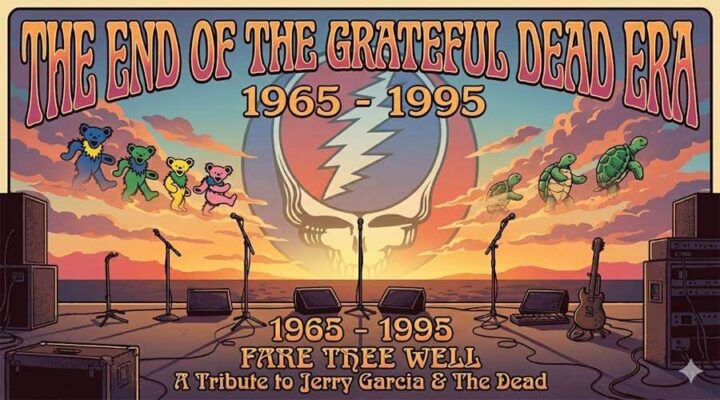
To understand the importance of Dead & Company, it’s necessary to go back to the emotional ending of the Grateful Dead.
Life After Jerry Garcia
August 9, 1995 remains one of the most significant dates in rock history. On that day, Jerry Garcia – the legendary lead guitarist and creative force behind the Grateful Dead – passed away.
Garcia’s influence on the band went far beyond playing guitar. His melodic style, emotional songwriting, and improvisational instincts defined the band’s identity for three decades.
Without him, the remaining members – Bob Weir, Phil Lesh, Bill Kreutzmann, and Mickey Hart – decided that the Grateful Dead could not continue under the same name.
For the community of fans known as Deadheads, it felt like the end of an era. The traveling culture surrounding the band had suddenly stopped.
But the music itself never truly disappeared.
Transitional Projects That Kept the Music Alive
Although the Grateful Dead had ended, its members continued performing in various projects over the following decades.
These bands helped keep the catalog alive while giving musicians space to experiment.
Some of the most notable projects included:
RatDog
Bob Weir’s long-running band that explored both Grateful Dead songs and new material.
Phil Lesh and Friends
A rotating lineup of musicians performing extended improvisations of Dead classics.
The Other Ones, The Dead, and Furthur
Projects that reunited former members at different points during the 2000s.
While these groups kept the music alive, fans still felt something was missing. None of them truly felt like a new chapter.
That moment would not arrive until 2015.
How John Mayer Discovered the Grateful Dead
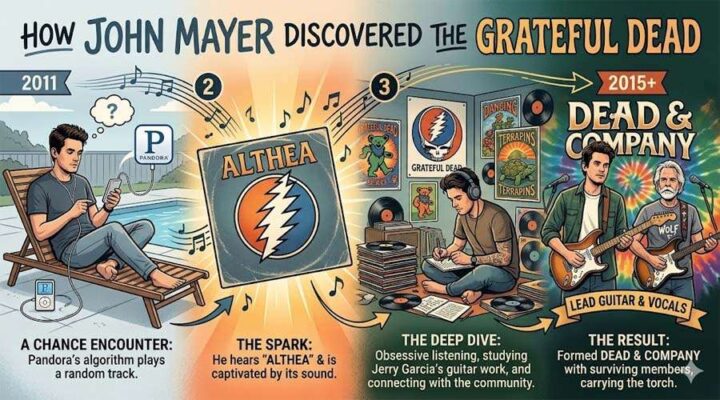
While longtime fans were still following the surviving members’ projects, something unexpected was happening elsewhere in the music world.
Guitarist John Mayer was about to discover the Grateful Dead.
A Life-Changing Moment with “Althea”
In 2011, Mayer was recovering from vocal cord surgery and spending time away from the spotlight. During that quiet period, he began listening to music he had previously overlooked.
One day, while sitting by a pool in California, he heard a song playing on a streaming radio station.
It was “Althea.”
The track immediately caught his attention. The groove, the unusual chord movement, and the relaxed conversational style of the guitar lines were unlike anything he had explored before.
Mayer later described the moment as a kind of musical awakening.
Instead of simply enjoying the song, he began studying it.
Diving Deep Into the Grateful Dead Catalog
What started as curiosity quickly turned into obsession.
Mayer began listening to the band’s studio albums like American Beauty and Workingman’s Dead. Soon he moved deeper into live recordings such as Europe ’72 and the legendary Cornell 1977 performance.
He became fascinated with the improvisational language of the band – especially the guitar work of Jerry Garcia.
The influence even began appearing subtly in Mayer’s own music during this period.
But he still had no idea that he would eventually perform these songs on stage with the original members.
The First Meeting Between John Mayer and Bob Weir
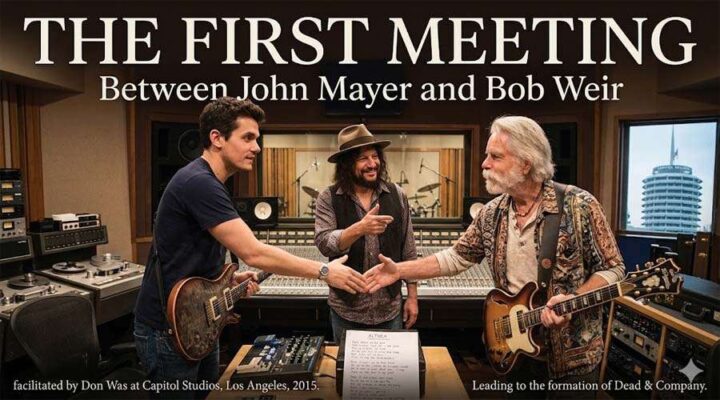
Every band has an origin moment that feels almost accidental.
For Dead & Company, that moment happened on television.
Crossing Paths on Late Night Television
In early 2015, John Mayer guest-hosted The Late Late Show. Because he was hosting, he had the chance to choose the musical guest.
His choice surprised many viewers: Bob Weir.
When the two musicians met backstage, the connection was immediate. Both were passionate guitarists who deeply respected the history of the instrument.
Their conversation quickly moved from small talk into detailed discussions about Grateful Dead songs and guitar phrasing.
The Jam That Started Everything
During the show, Mayer and Weir performed two songs together:
Althea
Truckin’
The chemistry was obvious.
Weir’s rhythmic, jazz-influenced guitar style created the perfect space for Mayer’s expressive leads. Rather than trying to copy Jerry Garcia, Mayer approached the music with respect while adding his own blues-influenced voice.
The performance worked so well that the two musicians continued playing together privately afterward.
That jam session planted the idea for something bigger.
The Formation of Dead & Company in 2015
Around the same time, former Grateful Dead members had just completed the massive Fare Thee Well reunion concerts.
Those shows were marketed as the final performances of the original lineup.
However, Bob Weir, Bill Kreutzmann, and Mickey Hart still wanted to keep playing.
At the same time, bassist Phil Lesh decided to step away from large tours. That created an opportunity to build a new lineup.
Assembling the Band
To make the project work, the musicians needed more than talented players. They needed people who understood the improvisational spirit of the Grateful Dead.
The final lineup included:
Bob Weir – rhythm guitar and vocals
John Mayer – lead guitar
Bill Kreutzmann – drums
Mickey Hart – drums
Oteil Burbridge – bass
Jeff Chimenti – keyboards
Each musician brought something essential.
Burbridge added melodic bass lines that honored the complexity of the original songs. Chimenti, who had previously played with RatDog and Furthur, provided deep familiarity with the catalog.
Together, the group became Dead & Company.
You can learn more about each musician in our guide to Dead & Company band members.
The Historic First Show
The band made its debut on October 31, 2015 at Madison Square Garden.
The anticipation was enormous. Fans wanted to see whether this new lineup could truly capture the spirit of the original band.
They opened with Playing in the Band, a bold choice that signaled their intentions.
This was not going to be a nostalgia act. They were going to improvise, stretch songs, and perform the music the same way the Grateful Dead always had.
The show was widely considered a success.
Early Tours and Fan Reception
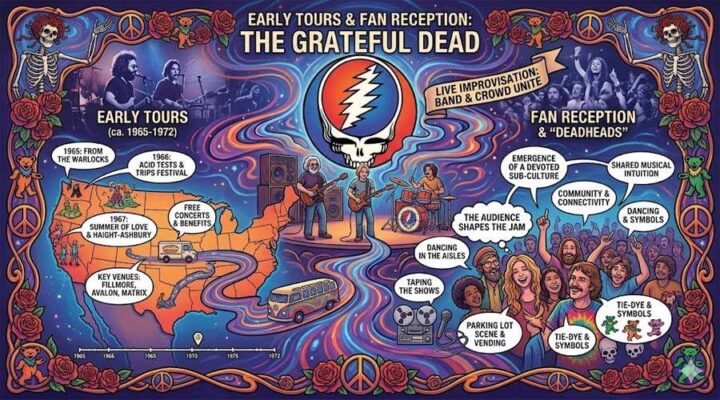
Launching a band is difficult. Winning over the Grateful Dead fanbase is even harder.
But over time, Dead & Company began to prove itself.
The First Tour
Shortly after the debut show, the band launched a full national tour.
Learning the Grateful Dead catalog is famously challenging. There are hundreds of songs, unusual chord structures, and an expectation of spontaneous improvisation.
Despite the challenge, the band quickly developed chemistry on stage.
Their concerts began featuring long jams that moved between psychedelic textures, blues solos, and exploratory improvisation.
You can explore how these tours evolved over time in our Dead & Company tour history guide.
Winning Over the Deadheads
At first, many longtime fans were skeptical.
Some wondered whether a modern pop-blues guitarist like John Mayer belonged in the band.
But as the tours continued, opinions changed.
Mayer approached the music with humility and clear respect for the tradition. Instead of trying to replace Jerry Garcia, he focused on interpreting the songs in his own voice.
Gradually, fans began embracing the new lineup.
The famous Shakedown Street parking lot scene returned, filled with vendors, artwork, and fans celebrating the culture around the band.
Something special had happened.
Dead & Company had successfully connected multiple generations of listeners.
Conclusion
The story of Dead & Company proves that music can evolve without losing its soul.
What began as a random streaming moment with the song “Althea” eventually led to one of the most unexpected collaborations in modern rock history.
By combining the experience of original Grateful Dead members with the fresh energy of John Mayer, the band created a new chapter for the music that millions of fans love.
And in the spirit of the Grateful Dead, one truth still holds:
The music never stops.
If you want to continue exploring the band’s journey, their music, and their influence on modern jam bands, read our complete Dead & Company guide.