
Why John Mayer Joined Dead & Company and Changed the Band Forever
Why John Mayer Joined Dead & Company
When the rumors first appeared in 2015 that John Mayer would form a band with the surviving members of the Grateful Dead, the music world was completely caught off guard. To casual listeners, the mainstream media, and even veteran jam band fans, it seemed like a strange and almost impossible pairing.
How does the singer-songwriter behind early 2000s acoustic pop hits like “Your Body Is a Wonderland” end up on stage performing thirty minute psychedelic jams like “Dark Star”?
However, musicians and longtime fans who understood Mayer’s deep blues guitar background saw the potential immediately. Beneath the tabloid headlines and the polished pop image was a serious guitarist with a deep respect for improvisation, vintage gear, and musical exploration.
Over the next several years, Dead & Company became one of the most successful touring acts in the world. The band played sold out baseball stadiums across the United States and later launched a historic residency at the Las Vegas Sphere.
Mayer’s role did more than simply keep the music alive. His presence helped introduce the enormous catalog of the Grateful Dead to an entirely new generation of fans.
If you want a broader overview of the band itself, you can read our Complete Dead & Company Guide, where we explore the band’s history, lineup, tours, and cultural legacy.
This article focuses on one specific question: why John Mayer joined Dead & Company and how such an unlikely collaboration became one of the most fascinating partnerships in modern rock history.
John Mayer’s Role in Dead & Company
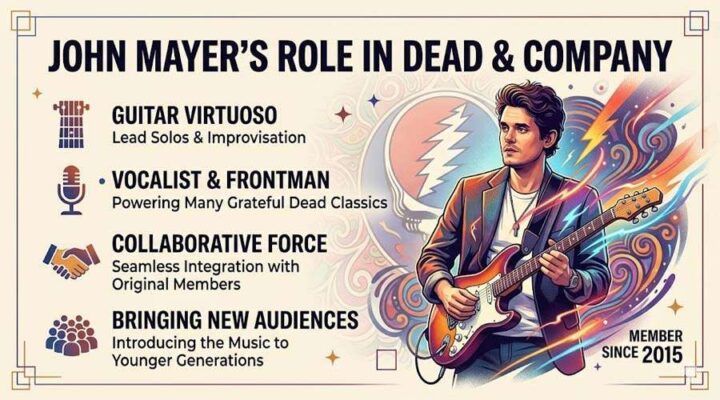
Before exploring the history behind the collaboration, it is important to understand Mayer’s role inside the band.
From the very beginning, Mayer was never presented as a replacement for the legendary guitarist Jerry Garcia. Instead, he serves as the lead guitarist, co lead vocalist, and musical interpreter of Garcia’s original parts.
Alongside founding members Bob Weir, Mickey Hart, and Bill Kreutzmann (and later drummer Jay Lane), bassist Oteil Burbridge, and keyboardist Jeff Chimenti, Mayer performs the intricate lead guitar lines that define the Grateful Dead sound.
Vocally, Mayer sings many songs originally associated with Jerry Garcia, including fan favorites like:
-
Sugaree
-
Althea
-
Brown Eyed Women
-
Bertha
The role requires an incredibly delicate balance. Mayer must respect the original melodies and arrangements while embracing the improvisational freedom that defines every Grateful Dead performance.
Some nights a song follows a familiar structure. Other nights it expands into a fifteen minute jam filled with unexpected turns.
For a deeper breakdown of the musicians and their roles, see our guide to Dead & Company Band Members.
John Mayer’s Career Before Dead & Company

To understand the scale of Mayer’s transition, it helps to look at the massive solo career he had already built before joining the band.
A Pop Star with Deep Blues Roots
John Mayer first rose to fame in the early 2000s with his debut album Room for Squares. The record produced several radio hits and quickly turned him into one of the most recognizable singer songwriters of the decade.
His follow up album Heavier Things continued that momentum and cemented his reputation as a major pop artist.
However, fellow musicians often noticed something deeper beneath the pop success. Mayer was obsessed with blues guitar and spent years studying legendary players such as:
-
Stevie Ray Vaughan
-
B.B. King
-
Albert King
-
Eric Clapton
These influences shaped the foundation of his guitar style.
The Shift Toward Improvisation
The blues influence became even more obvious when Mayer formed the John Mayer Trio with bassist Pino Palladino and drummer Steve Jordan.
Around the same time he released the critically acclaimed album Continuum. The record combined pop songwriting with serious blues guitar playing and earned multiple Grammy Awards.
Live performances like Where the Light Is: John Mayer Live in Los Angeles showed another side of Mayer. On stage he stretched songs into long improvisational solos and blues jams.
Those improvisational instincts would later become essential once he entered the world of the Grateful Dead.
Discovering the Grateful Dead

Like many modern fans, John Mayer discovered the Grateful Dead almost by accident.
The Pandora “Althea” Moment
Around 2011 Mayer was listening to a random streaming playlist while relaxing at home when a live version of Althea started playing.
The song immediately captured his attention.
Jerry Garcia’s guitar tone sounded unlike anything Mayer had studied before. It blended blues phrasing, country influenced picking, and modal improvisation into a completely unique style.
Mayer later described the experience as a moment of pure musical curiosity. He wanted to understand how this music worked.
Diving Into the Live Recordings
After that moment, Mayer began exploring the band’s massive catalog.
He listened to classic studio albums such as:
-
American Beauty
-
Workingman’s Dead
But he quickly discovered that the real magic of the Grateful Dead existed in live recordings.
Legendary concerts like the Europe ’72 tour and the famous Cornell 5/8/77 show became essential listening.
Mayer approached the music like a student. He analyzed Jerry Garcia’s use of the mixolydian scale, the band’s unusual chord structures, and the fluid improvisation that defined their concerts.
Before long, Mayer had become a genuine Deadhead.
How John Mayer Joined Dead & Company

The path from fan to band member happened surprisingly quickly.
In early 2015 Mayer guest hosted The Late Late Show and invited Bob Weir to appear as a musical guest.
During the program they performed songs together including Truckin’ and Althea. The chemistry between the two musicians was immediately obvious.
Weir noticed that Mayer understood the musical language of the Grateful Dead. He was not simply copying guitar licks. He knew how to interact with the rhythm and space inside the songs.
Around the same time, former members of the Grateful Dead were preparing for the famous Fare Thee Well concerts, which celebrated the band’s fiftieth anniversary.
After those historic shows, Weir, Kreutzmann, and Hart realized they still wanted to continue playing together.
They remembered the connection they felt with Mayer and began rehearsing privately in Los Angeles.
Mayer took the opportunity extremely seriously. He paused his own touring schedule and spent months studying the massive Grateful Dead songbook.
By late 2015 the new group was officially announced as Dead & Company.
If you want the full origin story of the band, read our article on How Dead & Company Was Formed.
John Mayer’s Musical Impact
Mayer’s arrival dramatically shaped the live sound of the band.
A New Guitar Energy
While Mayer carefully studied Jerry Garcia’s style, he never tried to copy it exactly.
Garcia’s approach often focused on fluid melodic lines and bright tones. Mayer added a slightly heavier blues influence and more aggressive string bending.
Working with Paul Reed Smith, Mayer also developed custom guitars designed specifically for Dead & Company performances.
The result created a powerful blend of classic Grateful Dead improvisation and modern blues rock energy.
Songs like:
-
Playing in the Band
-
Help on the Way
-
Morning Dew
often expanded into long improvisational journeys during Mayer’s solos.
His musical chemistry with keyboardist Jeff Chimenti also became a highlight of the band’s concerts.
Bringing New Fans to the Scene
Perhaps Mayer’s biggest contribution was bringing new audiences into the Grateful Dead universe.
Many younger listeners originally discovered Mayer through albums like Continuum. When he joined Dead & Company, those fans began exploring the band’s deeper musical history.
Concert crowds quickly became a blend of longtime Deadheads and curious new listeners.
The Revival of Shakedown Street Culture
Outside many venues, fans gather in the famous parking lot marketplace known as Shakedown Street.
Here you find everything from food vendors to handmade posters and vintage band shirts.
Younger fans quickly embraced this tradition. It became common to see a college student wearing a modern John Mayer tour shirt standing next to a longtime Deadhead wearing a faded 1980s Grateful Dead tee.
Tie dye shirts, bootleg posters, and handmade merchandise once again became a central part of the culture.
Many of the songs that defined this live experience appear in our guide to the Best Dead & Company Songs.
Early Fan Reactions
Not every fan immediately embraced the idea of John Mayer joining the band.
Some longtime Deadheads were skeptical. Mayer’s background as a mainstream pop artist seemed very different from the counterculture image of the Grateful Dead.
Online forums and message boards were filled with debate during the band’s early tours.
However, Mayer handled the situation with humility. Instead of acting like a celebrity guest, he focused on learning the music and supporting the band.
As recordings from the first tours spread online, opinions began to shift.
Fans heard Mayer’s dedication, his technical skill, and his obvious love for the music. Gradually he earned widespread respect inside the community.
A New Chapter in the Grateful Dead Story
Over time Dead & Company became one of the most successful touring acts in North America.
The band played stadium shows across the country and broke attendance records at venues such as:
-
Folsom Field
-
Wrigley Field
Although the band completed its final national tour in 2023, the story continued with a groundbreaking residency at the Las Vegas Sphere in 2024.
Through these performances the music reached audiences far beyond the original generation of fans.
Conclusion
The story of why John Mayer joined Dead & Company ultimately highlights the universal power of music.
A guitarist known for acoustic pop songs heard a single Grateful Dead track, became fascinated by its improvisational spirit, and followed that curiosity all the way to the biggest stages in the world.
Through dedication, deep study, and genuine respect for the original material, Mayer became an essential part of the modern Dead & Company era.
His involvement helped carry the Grateful Dead legacy into the twenty first century and introduced the band’s music to millions of new listeners.
And as Deadheads have always said:
the music never stops.