
Grateful Dead Logo Meaning: Symbols, Bears, and Skull Explained
When you think of the most iconic visual identities in the history of rock and roll, a select few images instantly come to mind. The Rolling Stones’ provocative tongue and lips, the Ramones’ punk-rock presidential seal, and Nirvana’s dizzy, crossed-out smiley face are all undeniable, unquestionable legends. However, arguably no other musical act has generated a visual universe quite as expansive, recognizable, and culturally significant as the Grateful Dead.
The Grateful Dead logo is not just a single static design. It is an entire interconnected system of symbols, characters, and motifs that has evolved over several decades, becoming deeply embedded in both music history and modern fashion culture. Even people who have never listened to a single sprawling, twenty-minute live jam of “Dark Star” can immediately recognize their artwork.
These striking visuals appear absolutely everywhere, from vintage tour t-shirts and dorm room posters to high-end modern streetwear collaborations and colorful festival outfits. But to truly understand these symbols, you have to look past the ink and cotton.
More importantly, these designs are not just corporate branding. For the fans, they represent identity, freedom, and a shared, lifelong connection to one of the most unique musical movements in human history. Let’s take a long, strange trip into the band’s history and break down the deep meanings behind the Grateful Dead’s most iconic symbols.
1. The Steal Your Face Skull: The Ultimate Grateful Dead Logo
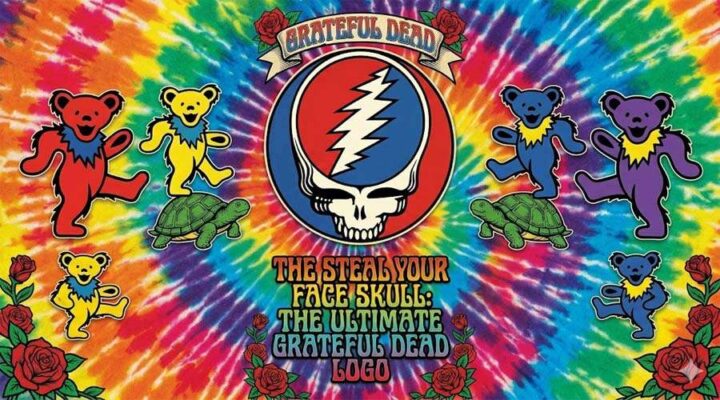
If there is one primary image that serves as the definitive Grateful Dead logo, the undisputed crest of the band, it is the “Steal Your Face” skull. Often affectionately referred to by fans simply as the “Stealie,” this emblem is the beating heart of the band’s visual identity.
Origins of the Design
The design features a grinning human skull set inside a perfect circle, split right down the middle by a bold, jagged lightning bolt. The traditional colors are a stark, patriotic red, white, and blue. While it looks like a carefully crafted piece of psychedelic album art, its origins were surprisingly practical and born out of necessity.
In the late 1960s, the Grateful Dead were playing massive, chaotic, multi-band music festivals. The backstage areas were a mess of shared equipment, and it was notoriously easy for a band’s heavy road cases and amplifiers to get lost, mixed up, or even outright stolen. The band needed a way to quickly and easily identify their equipment.
Their visionary sound engineer, Owsley “Bear” Stanley, realized they needed a distinct, easily recognizable stencil. He came up with the initial concept of a circle divided by a lightning bolt in patriotic colors. He then collaborated with his friend, graphic designer Bob Thomas, who took the concept, refined it, and added the iconic grinning skull to the center. What started as a simple backstage marking system quickly evolved into one of the most famous logos in music history, eventually serving as the cover art for the band’s 1976 live album, Steal Your Face.
Meaning Behind the Skull
In classical art, a skull is a memento mori, a sobering reminder of human mortality and the temporary nature of life. However, in the context of the Grateful Dead, the skull carries a much deeper, more unifying message.
The skull represents raw, stripped-down humanity. It suggests that beneath our skin, beneath our clothes, and beneath all of our rigid societal labels, we are fundamentally exactly the same. It is a powerful equalizing symbol. This idea resonated strongly with the counterculture movement of the 1960s, promoting peace, equality, and the shedding of ego.
Meaning Behind the Lightning Bolt
The lightning bolt crashing through the skull represents pure energy, sudden transformation, and sudden bursts of inspiration.
It perfectly reflects the unpredictable, electrifying nature of the band’s music, especially during their legendary, heavily improvised live performances. The bolt is traditionally drawn with exactly 13 points. While this has led to countless elaborate fan theories like claims it represents the original 13 American colonies, a 13-step LSD manufacturing process, or even a nod to the occult, Owsley Stanley himself stated that 13 was simply the number of points that aesthetically fit the best inside the circular design.
2. The Dancing Bears: Movement, Joy, and Psychedelic Culture
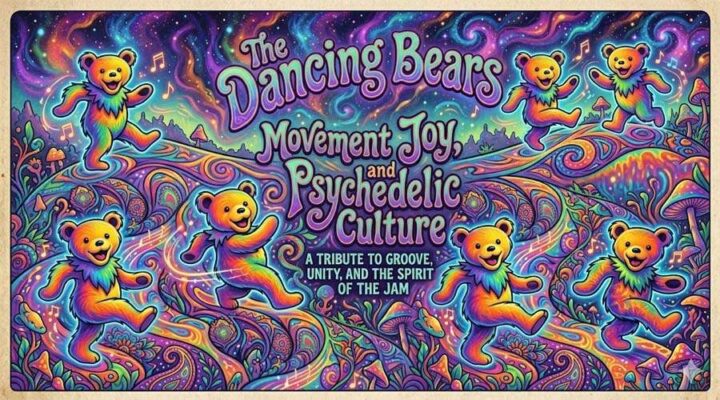
If the Stealie is the band’s serious, hard-rocking, definitive emblem, the brightly colored line of fuzzy bears is their joyful, whimsical counterpart. Another massive pillar in the Grateful Dead universe, these colorful bears can be found plastered across everything from tie-dye apparel to bumper stickers.
They Are Not Actually Dancing
Here is a piece of band trivia that surprises even some longtime Deadheads: the bears aren’t actually dancing.
These brightly colored characters first appeared on the back cover of the band’s 1973 live album, History of the Grateful Dead, Volume One (Bear’s Choice). The artwork was once again created by the talented Bob Thomas. According to Owsley Stanley, who inspired the bears because his nickname was “Bear” due to his hairy, barrel-chested look, the bears are actually doing a high-stepping march. However, the fans immediately interpreted their joyful stances as dancing, and the name permanently stuck to the culture.
Symbolic Meaning of the Bears
Despite their marching origins, the bears represent several incredibly important aspects of the Grateful Dead experience.
Movement and Rhythm: The bears represent the continuous, joyful physical movement of the band’s live shows. When the band hit a deep groove, the entire audience would move as a single, breathing organism. The bears capture that innocent, euphoric feeling of spinning freely in a field.
Joy and Freedom: There is an undeniable innocence to the bears. They remind fans not to take life too seriously and to embrace childlike joy.
Psychedelic Aesthetic: The vibrant, neon colors of the bears (typically blue, green, yellow, orange, and pink) perfectly encapsulate the LSD-soaked, vibrant visual aesthetic of the late 1960s and 1970s.
Connection to Fan Culture
The bears became especially popular among fans because they are playful, approachable, and highly adaptable. They perfectly capture the warm, welcoming spirit of the Deadhead community, acting as friendly mascots for a nomadic tribe of music lovers.
3. Beyond the Skull and Bears: Other Iconic Grateful Dead Symbols
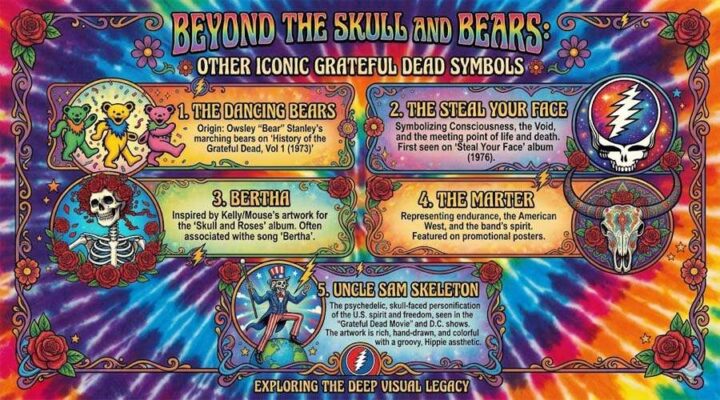
While the Stealie and the Dancing Bears are undoubtedly the most famous, the band’s visual identity includes an incredibly deep roster of other important elements. Collaborating with legendary poster artists like Stanley Mouse, Alton Kelley, and Rick Griffin helped expand this visual universe.
Skull and Roses (Bertha)
This legendary design features a skeleton with a crown of lush red roses. It was famously created by Stanley Mouse and Alton Kelley for a 1966 concert poster advertising a show at the Avalon Ballroom in San Francisco. The artists actually lifted the core image from a 19th-century illustration by Edmund Sullivan for an edition of the Rubaiyat of Omar Khayyam.
It is a visual pun on the band’s name, with the skeleton representing the “Dead” and the blooming, beautiful roses representing the “Grateful.” Fans often refer to this skeleton simply as “Bertha,” named lovingly after the classic Grateful Dead song. It represents the delicate balance between life and death, beauty and decay.
Skeletons and the Macabre
Skeletons appear everywhere in Grateful Dead artwork. However, unlike traditional representations of skeletons that are meant to evoke fear, gothic darkness, or doom, these skeletons are often shown as playful, lively, and musical. You will see skeletons playing fiddles, grinning in top hats, or tossing roses. This reflects the band’s philosophical perspective that life and death are part of the same beautiful, natural cycle, encouraging fans to celebrate the moment while they are still here.
Psychedelic Typography
The band’s concert posters and album covers often featured highly distorted, flowing, and melting lettering. Influenced by the mind-bending visuals of a psychedelic trip, this typography by artists like Rick Griffin was designed to create a more immersive visual experience. It wasn’t just meant to be read; it was meant to be deciphered and experienced, forcing the viewer to stop and engage deeply with the art.
4. The Vision Behind the Art: The Role of Owsley Stanley
To fully understand the Grateful Dead’s visual identity, it is absolutely crucial to recognize the massive influence of Owsley “Bear” Stanley. He was not just a sound engineer; he was a major creative force behind the scenes and a true architect of the 1960s counterculture.
Owsley was a perfectionist. Not only did he design the band’s revolutionary, towering “Wall of Sound” speaker system, which changed live concert audio forever, but he was also one of the primary underground chemists producing LSD in the San Francisco Bay Area during the Summer of Love.
His deep, intimate understanding of the psychedelic experience helped shape both the sound and the visual identity of the band. He understood that when fans were at a concert having a profound, mind-expanding experience, they needed strong, recognizable visual anchors. He essentially acted as the art director for an entire cultural movement, ensuring the band’s logos were bold, symbolic, and perfectly matched the exploratory nature of their music.
5. Why the Grateful Dead Logo Became a Cultural Phenomenon
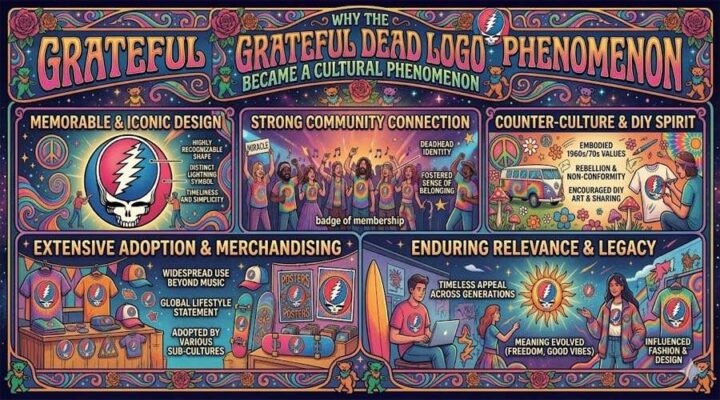
Why did the Grateful Dead’s symbols outlast almost all of their peers? How did a band famous for their loose, anti-commercial stance create a brand identity that rivals major global corporations? The answer lies in how they interacted with their audience.
Connection to Live Music Culture
The band’s imagery grew entirely alongside their live performances. Fans didn’t just see a logo on a CD case in a store; they encountered these symbols at massive outdoor concerts, on hand-drawn posters, and scribbled on shared bootleg cassette tapes. This deep, personal connection made the logos far more meaningful than traditional corporate branding.
The Role of Deadheads and “Shakedown Street”
The fan community, the Deadheads, played the biggest role in spreading the imagery. Wherever the band played, a sprawling, nomadic parking lot economy known as “Shakedown Street” would magically appear.
In these lots, fans sold homemade grilled cheese, artisan crafts, and most importantly, bootleg merchandise. Fans created their own localized, DIY versions of the logos. They tie-dyed them, painted them on the backs of denim jackets, and altered them to feature inside jokes. The band allowed this to happen, realizing that allowing the fans to “own” the imagery helped the designs evolve organically over time.
Simple but Powerful Design
The bold shapes and strong contrast of the logos make them incredibly easy to recognize. A 13-point lightning bolt can be spotted from across a muddy festival campground. This brilliant simplicity is one of the main reasons the designs have remained relevant for over half a century.
6. Grateful Dead Merch and Fashion Influence
Over time, the Grateful Dead logo has transcended the realm of music and become a massive, undeniable force in global fashion. What started as parking lot bootlegs has evolved into a highly respected aesthetic.
Vintage T-Shirts as Holy Grails
In the world of vintage clothing collectors, authentic Grateful Dead concert t-shirts from the 1970s, 80s, and 90s are considered absolute “holy grails.” Collectors and fashion enthusiasts are willing to pay hundreds, sometimes thousands of dollars for original, paper-thin, perfectly faded tour shirts. The intricate, tour-specific artwork makes each vintage shirt a wearable piece of American history.
Streetwear and High Fashion Collabs
Modern streetwear brands have wholeheartedly embraced the Grateful Dead aesthetic, bringing it into mainstream fashion. The band’s estate has collaborated with massive brands, most notably releasing the highly coveted “Nike SB Dunk Low Grateful Dead Bears” sneakers, which featured fuzzy suede and hidden stash pockets. Independent streetwear heavyweights like Online Ceramics have built entire brands heavily inspired by the DIY, bootleg aesthetic of 1980s Grateful Dead lot shirts.
Festival Fashion Staples
Even today, these designs are widely worn at festivals, concerts, and in casual streetwear settings. Walk around any major music festival in the world, and you are guaranteed to see a sea of tie-dye, Steal Your Face patches, and Dancing Bear bucket hats. They represent a broader love for live music and a carefree, bohemian lifestyle.
👉 Looking to bring that iconic, timeless style into your wardrobe? Whether you are heading out to a summer festival, expanding your streetwear collection, or just want to rep one of the greatest bands of all time, [Check out our exclusive collection of Grateful Dead inspired shirts and merch right here].
Conclusion
The Grateful Dead logo is far more than just graphic design. It is a visual language that represents an entire cultural movement. From the striking Steal Your Face skull to the joyful, marching colorful bears, each symbol carries decades of deep meaning, history, and emotion.
Together, these elements form one of the most powerful, flexible, and enduring visual identities in music history. The influence of the Grateful Dead did not end with the passing of Jerry Garcia or the end of the original band. Today, projects like Dead & Company continue to carry the music and visual identity forward to sold-out stadiums, introducing it to entirely new generations of fans.
Even today, half a century after they were first drawn, these images continue to connect fans across generations, acting as a beacon for free spirits and keeping the beautiful, wandering spirit of the Grateful Dead alive.