
Dead & Company Final Tour: The End of an Era
Dead & Company Final Tour
For eight unforgettable years, Dead & Company carried the torch, keeping the strange, beautiful, and improvisational fire burning. From their surprise debut in 2015 to the final emotional performances by the San Francisco Bay, the band became far more than a tribute project.
Instead, they evolved into a living continuation of the musical legacy created by Grateful Dead.
When the band announced their Final Tour for summer 2023, the entire Deadhead community seemed to pause at once. Fans everywhere understood the significance immediately. This was not simply the end of a tour cycle. It marked the closing chapter of an important era in modern jam band history.
If you want a full overview of the band’s story, lineup, and music, you can read our complete guide to Dead & Company. This article focuses specifically on the emotional and historic final tour that brought their eight-year journey to a close.
For longtime Deadheads and newer fans alike, the Final Tour became more than just a concert series. It was the culmination of a psychedelic musical journey that began decades earlier during the 1960s counterculture with the Grateful Dead.
When Dead & Company Announced Their Final Tour
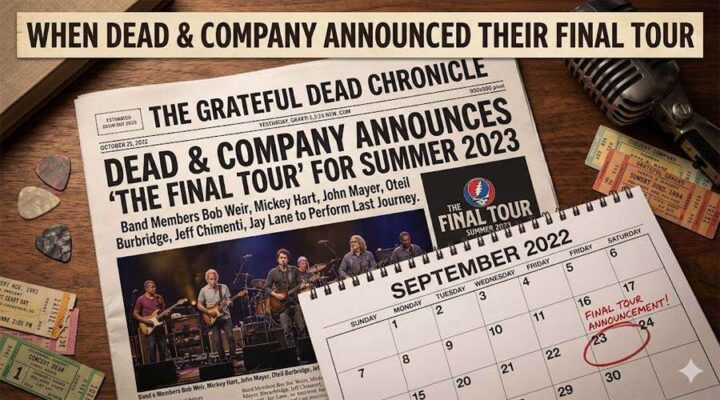
The announcement arrived suddenly in September 2022, spreading quickly across the jam band community. Social media filled with reactions as the band confirmed that Summer Tour 2023 would be their final large-scale tour.
The lineup for the farewell run included:
-
Bob Weir – Rhythm Guitar, Vocals
-
Mickey Hart – Drums, Percussion
-
John Mayer – Lead Guitar, Vocals
-
Oteil Burbridge – Bass, Vocals
-
Jeff Chimenti – Keyboards
-
Jay Lane – Drums
Jay Lane stepped in after Bill Kreutzmann stepped away from touring due to health concerns.
At the time of the announcement, many fans were surprised because the band was performing at an extremely high level.
John Mayer had fully embraced the improvisational spirit of the Grateful Dead catalog. His guitar playing honored the iconic sound of Jerry Garcia while still developing its own modern voice.
Rather than fading as a nostalgia act, the band sounded stronger and more adventurous than ever.
Why Dead & Company Decided to End Touring
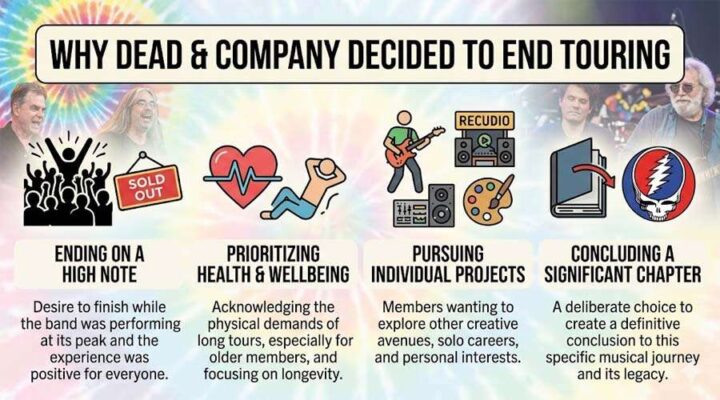
Unlike many rock bands that end due to conflicts or dramatic breakups, Dead & Company never announced any major internal tension. The decision appeared to be a mutual agreement to step away from the intense demands of large stadium tours.
The Age of the Original Members
One important factor was simply time.
Bob Weir was born in 1947, while Mickey Hart was born in 1943. After nearly sixty years of performing, maintaining a schedule of thirty stadium shows across the country becomes physically exhausting.
Ending the touring era while the band was still performing at a high level allowed them to preserve the integrity of their live performances.
The Reality of Stadium Touring
Modern stadium tours involve massive logistics.
Transporting stage equipment, sound systems, lighting rigs, and crew members across dozens of cities requires enormous coordination and energy. The band ultimately decided to conclude the touring chapter on their own terms rather than push beyond sustainable limits.
By announcing the final tour in advance, the band turned the ending into a celebration instead of a quiet goodbye.
Highlights From the Dead & Company Final Tour
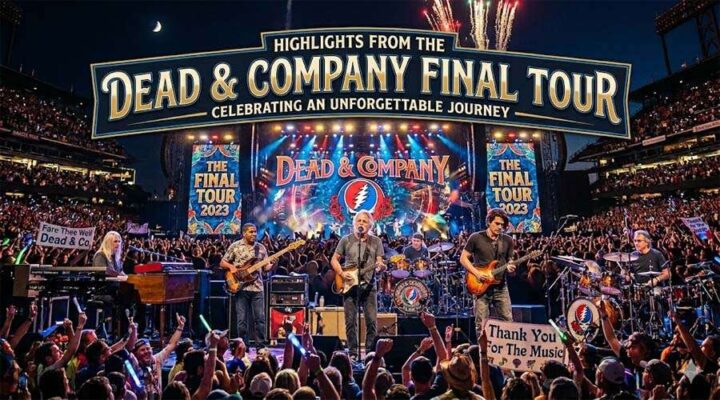
Dead & Company approached their farewell tour with incredible energy. Rather than slowing down, many fans believe the band delivered some of the strongest performances of their entire run.
If you’re curious about their most iconic performances, you can also explore our guide to the best Dead & Company songs and live performances.
Record-Breaking Tour Success
The Final Tour became the most successful tour of the band’s career.
Industry reports estimate that the tour generated over $115 million in revenue and sold more than 845,000 tickets.
Major venues across the United States quickly sold out, including:
-
Wrigley Field in Chicago
-
Citi Field in New York
-
Kia Forum in Los Angeles
Throughout the tour, the band performed more than 100 different songs from the Grateful Dead catalog.
True to the Dead tradition, no two shows had the same setlist.
Cornell 1977 Revisited
One of the most historically meaningful moments occurred on May 8 at Cornell University.
The band returned to Barton Hall exactly 46 years after the legendary 1977 Grateful Dead concert widely considered one of the greatest live shows in rock history.
Performing classics like Scarlet Begonias and Fire on the Mountain in the same venue created a powerful connection between generations of fans.
Drone Light Shows
Several outdoor concerts featured spectacular drone light shows.
Hundreds of synchronized drones formed iconic Grateful Dead imagery above the stadium, including:
-
the famous Steal Your Face skull
-
the dancing bears
-
giant skeleton figures floating across the sky
The visuals added a modern technological layer to the psychedelic atmosphere that has always defined Dead concerts.
Guest Appearance by Dave Matthews
During the Boulder shows at Folsom Field, fans received a surprise appearance from Dave Matthews.
Together they performed memorable versions of:
-
All Along the Watchtower
-
Not Fade Away
-
Knockin’ on Heaven’s Door
The collaboration created one of the most talked-about moments of the entire tour.
The Final Shows in San Francisco
The tour concluded with three emotional nights at Oracle Park in San Francisco.
This location carried deep symbolic meaning because the Grateful Dead originally formed nearby in the legendary Haight-Ashbury neighborhood during the 1960s.
More than 40,000 fans attended each night.
The final performance ended with the classic song Brokedown Palace. After the band left the stage, the crowd continued chanting the familiar line from Not Fade Away:
“You know our love will not fade away.”
It became a deeply emotional farewell moment for the community.
The Deadhead Community and Shakedown Street
For fans, the Final Tour felt less like a farewell and more like a massive reunion.
Across the country, thousands of Deadheads traveled from city to city following the band. Parking lots outside venues transformed into vibrant marketplaces known as Shakedown Street.
Here fans bought and traded:
-
vintage band shirts
-
tie-dye clothing
-
handmade art
-
tour posters
Graphic t-shirts have always been a major part of Deadhead culture. Each design tells a story tied to a specific tour, lyric, or city.
Buying merch at Shakedown Street is more than collecting souvenirs. It’s a way of supporting traveling artists and keeping the culture alive.
What Happens After the Final Tour
Although Dead & Company stopped touring, the musicians remain extremely active.
If you want a deeper look at each musician’s career, you can read our complete guide to Dead & Company band members.
Bob Weir & Wolf Bros
Bob Weir continues performing with Bob Weir & Wolf Bros, presenting stripped-down interpretations of the Grateful Dead songbook.
These concerts often feature orchestral arrangements and smaller theater settings.
John Mayer’s Solo Career
John Mayer returned to his solo touring schedule but has frequently said that the music of the Dead has become a permanent part of his artistic identity.
Many fans expect him to continue performing songs from the catalog in the future.
Oteil Burbridge and Jeff Chimenti
Oteil Burbridge continues touring with Oteil & Friends, while Jeff Chimenti remains one of the most respected keyboardists in the jam band world.
Mickey Hart and Jay Lane
Mickey Hart continues exploring world rhythm through projects like Planet Drum, while Jay Lane remains a highly sought-after drummer for various jam band collaborations.
Conclusion: The Music Never Stops
The Final Tour of Dead & Company marked the end of an extraordinary musical chapter.
For nearly a decade, the band successfully carried the spirit of the Grateful Dead to a new generation of fans while continuing to inspire longtime Deadheads.
From their first show in 2015 to the emotional farewell in San Francisco, Dead & Company proved that this musical tradition is larger than any single lineup.
Band names change. Musicians evolve. Tours eventually end.
But the spirit of the music – the improvisation, the community, and the sense of shared experience – continues.
As Deadheads have said for decades:
The music never stops.
FAQ
When did Dead & Company announce their Final Tour?
Dead & Company announced their Final Tour in September 2022, confirming that Summer Tour 2023 would be their last nationwide tour.
Where did Dead & Company play their final shows?
The band performed their final concerts at Oracle Park in San Francisco in July 2023.
Why did Dead & Company stop touring?
The band decided to stop large-scale touring mainly due to the physical demands of long stadium tours and the age of some original Grateful Dead members.