
Dead & Company vs Grateful Dead: What Changed and What Stayed the Same
Dead & Company vs Grateful Dead
You’re walking down the street and you spot that unmistakable red, white, and blue 13 point lightning bolt on a T-shirt. Or maybe it’s a beautifully faded vintage band shirt covered in those famous colorful dancing bears.
You instantly know it’s connected to “The Dead”. But which Dead?
For casual music fans and newcomers to the jam band scene, the difference between Grateful Dead and Dead & Company can be confusing at first glance. If you are just beginning to explore the massive archive of live recordings, you might find yourself asking a few simple questions.
- Are they the same band?
- Is one of them just a tribute act?
- Why is a blues rock pop star suddenly performing psychedelic songs from the late 1960s?
The two bands share a direct lineage, a legendary catalog of songs, and a deep commitment to improvisational live music. However, they are fundamentally different groups. They are separated by decades of history, huge advances in concert technology, and a defining moment in 1995 that changed the future of the band forever.
If you want a deeper overview of the modern band, you can also read our complete Dead & Company guide, where we explore the band’s history, lineup, and musical legacy.
This article focuses on a simple question many new fans ask when discovering the scene.
What exactly is the difference between the Grateful Dead and Dead & Company?
The Core Connection Between the Two Bands

Before comparing the differences between the two bands, it is important to understand why they are so closely connected.
Dead & Company is not a typical cover band. It is widely considered the official continuation of the musical tradition created by the Grateful Dead. The project was formed and led by members who helped create that original music.
Three key members from the Grateful Dead helped form Dead & Company in 2015.
Bob Weir – rhythm guitar and vocals
Mickey Hart – drums and percussion
Bill Kreutzmann – drums
Kreutzmann performed with the band from its formation until 2023 when he stepped away from touring and was replaced by drummer Jay Lane.
One major absence from the lineup is bassist Phil Lesh. After the Grateful Dead ended, Lesh chose to focus on his own projects such as Phil Lesh & Friends rather than commit to large stadium tours.
Even without Lesh, Dead & Company performs the same catalog of songs and preserves many classic traditions from the original band. Concerts still feature two sets and the experimental Drums → Space segment where the rhythm section explores extended improvisation.
When Bob Weir steps up to sing the emotional ballad Morning Dew today, he is not covering a song. He is continuing a musical journey that began more than fifty years ago.
The History of the Grateful Dead

To understand the significance of Dead & Company, you first need to understand the enormous cultural impact of the Grateful Dead.
The band formed in 1965 in the San Francisco Bay Area. They originally performed under the name The Warlocks before adopting the name Grateful Dead. The group soon became closely associated with author Ken Kesey’s Acid Tests, which placed them at the center of the psychedelic counterculture movement.
Their music was extremely difficult to categorize because it blended many different American genres.
- Folk and Americana
Chicago and Delta blues
Country and western
Avant garde jazz
Bluegrass
Psychedelic rock
Although they released beloved studio albums like American Beauty and Workingman’s Dead in 1970, the band became legendary because of its live concerts.
Fans known as Deadheads followed the band across the country. Concerts were famous for long improvisational jams and constantly changing setlists. Every show was different, which made seeing the band live a unique experience each night.
The Role of Jerry Garcia
No discussion about the Grateful Dead is complete without mentioning their iconic guitarist.
Jerry Garcia was the band’s lead guitarist, primary musical composer, and emotional center. Along with lyricist Robert Hunter, Garcia helped create many of the songs that defined the band’s legacy.
His guitar style blended bluegrass picking, blues phrasing, and jazz improvisation. Using custom guitars like Wolf and Tiger, Garcia developed a distinctive tone that became instantly recognizable.
More importantly, Garcia served as the spiritual figurehead of the Deadhead community. His voice and stage presence gave fans a sense of warmth and authenticity.
When Garcia passed away in August 1995, the remaining members decided to officially end the Grateful Dead. They felt the band could not continue under the same name without its central figure.
How Dead & Company Was Formed

After the Grateful Dead ended, the surviving members continued performing in various projects including The Other Ones, The Dead, and Furthur.
In 2015, the original core members reunited for the Fare Thee Well concerts celebrating the band’s 50th anniversary. These shows were widely promoted as the final performances of the classic lineup.
However, the music did not stop there.
Later in 2015, a new project emerged called Dead & Company.
For a deeper look at how the group came together, you can read our article explaining how Dead & Company was formed.
The Arrival of John Mayer
One of the most surprising aspects of Dead & Company was the addition of guitarist John Mayer.
Mayer first discovered the band through a streaming playlist and became fascinated by the song Althea. After meeting Bob Weir and playing together in a studio session, the musical chemistry was clear.
The rest of the lineup was completed by two highly respected musicians.
Oteil Burbridge – bass
Jeff Chimenti – keyboards
Despite early skepticism from some longtime fans, the band quickly proved they could honor the original music while adding their own personality.
If you want to learn more about each musician, see our guide to Dead & Company band members.
A Successor Band Rather Than a Tribute
From 2015 through their final tour in 2023, Dead & Company toured extensively across North America.
Interestingly, the band never released a studio album. Their focus remained entirely on live performances and keeping the concert tradition alive.
Their tours introduced younger audiences to classic songs such as:
- Scarlet Begonias
Truckin’
Touch of Grey
Playing in the Band
Many of these songs and their famous live versions are discussed in our guide to the best Dead & Company songs and live performances.
Musical Differences Between the Bands

Although both bands perform the same catalog, their sound and style are noticeably different.
Jerry Garcia vs John Mayer
The most obvious difference is the lead guitar approach.
Jerry Garcia’s playing was melodic and fluid, often exploring long scales and improvisational phrases.
John Mayer approaches the music from a blues rock perspective. His tone is thicker and warmer, often played through his PRS Silver Sky guitar. Mayer is heavily influenced by legendary blues guitarists such as:
- Stevie Ray Vaughan
B. B. King
Eric Clapton
Rather than copying Garcia’s style, Mayer interprets the songs through his own musical background.
Tempo Differences
Another noticeable difference is tempo.
Dead & Company performances tend to be slower than many classic Grateful Dead shows, particularly those from the energetic early 1980s.
Bob Weir has explained that a slower pace allows the band to explore deeper textures during improvisational sections.
The Live Concert Experience
Technology also plays a major role in the difference between the two eras.
The Grateful Dead were pioneers of live sound. In 1974 they built the famous Wall of Sound system, one of the most ambitious concert audio systems ever created.
Modern Dead & Company concerts use advanced lighting systems, high definition video screens, and powerful stadium sound technology.
This technological evolution reached a peak during the band’s residency at the Las Vegas Sphere in 2024, where immersive visuals combined with the band’s improvisational jams.
Deadhead Culture Then and Now
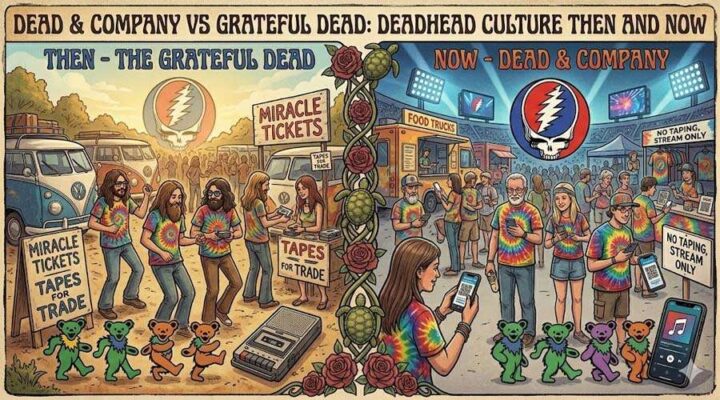
A Grateful Dead concert has always been about more than the music.
The Original Deadhead Era
In the 1970s and 1980s, Deadheads often traveled from city to city following the band.
Parking lots outside concerts became temporary marketplaces known as Shakedown Street. Fans sold homemade food, traded cassette recordings, and created handmade tie dye band shirts.
These shirts and bootleg designs became part of the band’s visual identity.
The Dead & Company Generation
Dead & Company concerts preserved many of these traditions but in a more modern setting.
Today the crowd is often multigenerational. Longtime fans who saw the original band share the audience with younger listeners who discovered the music through streaming platforms or through John Mayer.
Official band merchandise has also become extremely popular, with long lines forming for tour posters and vintage style band shirts.
Which Band Is Better?
Trying to decide which band is better misses the point.
The Grateful Dead created the culture, wrote the songs, and built the mythology.
Dead & Company carried that music into a new era and introduced it to a new generation of listeners.
Both bands represent different chapters of the same musical story.
Conclusion
The difference between the Grateful Dead and Dead & Company reflects two different eras of the same musical tradition.
The Grateful Dead created a cultural movement and helped define the jam band genre. Dead & Company continued that legacy by bringing the music into the modern concert era.
Although Dead & Company finished their final major tour in 2023 and performed their Sphere residency in 2024, the influence of this music continues to grow.
As fans have said for decades, the music never stops.
FAQ
Is Dead & Company the same as the Grateful Dead?
No. Dead & Company is a successor band formed in 2015. It performs the Grateful Dead catalog but operates under a different name out of respect for Jerry Garcia.
Who replaced Jerry Garcia in Dead & Company?
John Mayer performs the lead guitar role in Dead & Company. However, he does not attempt to replace Jerry Garcia and instead interprets the music in his own style.
When did Dead & Company stop touring?
Dead & Company concluded their final large national tour in 2023. They later performed a residency at the Sphere in Las Vegas in 2024.
Why isn’t Phil Lesh in Dead & Company?
Phil Lesh chose not to join Dead & Company when the band formed. Instead, he focused on his own collaborative project Phil Lesh & Friends.