
Grateful Dead Concerts: Legendary Live Shows and Tour History
If you ask any die-hard fan about Grateful Dead, they will immediately tell you one simple truth: you cannot truly understand this band until you experience their live shows.
Whether you are standing in a packed stadium or listening through headphones to an old cassette recording, the live setting is where everything comes to life. While studio albums like American Beauty and Workingman’s Dead are considered classics, the band was never defined by the studio. Instead, they built their identity on the stage.
The Grateful Dead were, above all else, a live phenomenon. Their concerts were not just performances. They were unpredictable, immersive journeys that completely changed what a rock show could be.
Over a 30-year career, the band created an entirely new culture around live music. Fans did not just attend shows in their hometown. They followed the band across the country, forming a traveling community. In this guide, we will explore what made these concerts so unique, highlight legendary performances, and explain why their live legacy still matters today.
👉 If you are new to the band, start with our complete guide to Grateful Dead to understand their full history and influence.
1. Why Grateful Dead Concerts Were Unique and Revolutionary
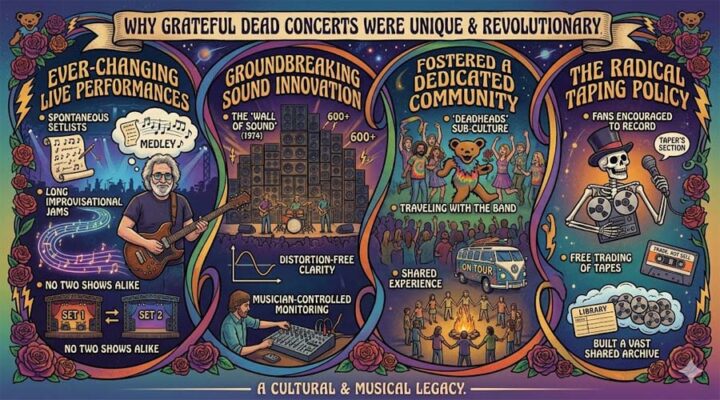
Before the Grateful Dead, most concerts followed a simple formula. Bands would tour an album and play nearly the same setlist every night. The goal was consistency.
The Grateful Dead completely broke that rule.
As pioneers of the jam band movement, their philosophy was clear: no two shows should ever be the same.
At the center of their performances was improvisation. Songs like “Dark Star” and “Playing in the Band” could expand far beyond their studio versions, often lasting 20 to 30 minutes. Each performance became a real-time musical conversation.
Led by Jerry Garcia, alongside Bob Weir and Phil Lesh, the band embraced unpredictability. There was no fixed setlist. Instead, they followed the energy of the crowd and the moment.
This approach came with risks. Not every jam worked perfectly. But when everything clicked, it created once-in-a-lifetime moments that fans could never experience again in the same way.
2. The Rise of Grateful Dead Touring Culture and Deadheads
The band’s live identity started in the 1960s in San Francisco during the counterculture movement. Early performances helped them develop a free-form, experimental style.
By the 1970s, the band was touring constantly. As they moved across the country, fans began to follow them.
These fans became known as Deadheads.
They quickly realized that every show was different. Seeing just one concert was not enough. To fully understand the band, you had to attend multiple shows.
One major reason this culture grew so strong was the band’s open attitude toward recording. Unlike most artists, they allowed fans to record concerts and even created a special section for tapers.
These recordings were shared across the country, creating a network of fans long before the internet existed. This helped build one of the most loyal communities in music history.
👉 To understand this culture deeper, read our full guide: Deadheads Explained: The Culture of Grateful Dead Fans
The Rules of the Tape Trading Network
The taping culture was not just a hobby; it was a highly organized network built on a strict code of ethics. Long before digital downloads, fans hauled heavy, professional-grade microphones and bulky reel-to-reel or cassette recorders into venues. The band gave them their blessing, but the community heavily enforced one golden rule: you could trade tapes, but you could never sell them for profit.
Maxell blank cassettes became the currency of the Deadhead world. Fans would meticulously copy shows for one another, spending hours creating intricate, hand-drawn art for the cassette insert cards (known as J-cards). This honor system ensured that the music remained in the hands of the fans. It also meant that if you wanted to hear that mind-bending 30-minute version of “Dark Star” from a random Tuesday night in Ohio, you had to engage with the community to find it. This tape trading network was essentially the world’s first social media platform, entirely fueled by a shared love for live music.
3. Legendary Grateful Dead Concerts
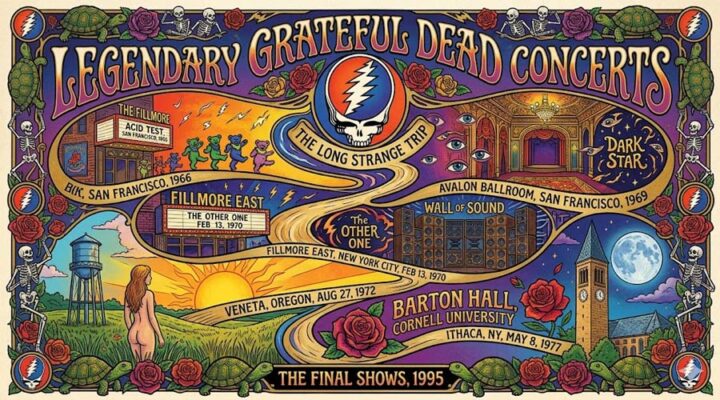
With more than 2,000 live shows, choosing the best Grateful Dead concerts is difficult. However, a few performances stand out as legendary.
Cornell 1977
The May 8, 1977 show at Cornell University is often considered the greatest Grateful Dead concert ever.
The transition between “Scarlet Begonias” and “Fire on the Mountain” is one of the most famous moments in their live history. The performance of “Morning Dew” is also widely praised for its emotional intensity.
Europe ’72 Tour
The 1972 European tour marked a major moment in the band’s evolution. They introduced a more refined sound while still keeping their improvisational style.
The live album Europe ’72 became one of their most popular releases, featuring songs like “Jack Straw” and “Ramble On Rose.”
Winterland Shows 1978
The band had a strong connection to Winterland Ballroom.
Their New Year’s Eve 1978 performance, known as “The Closing of Winterland,” was a massive event. The show lasted for hours and included guest appearances, a midnight countdown, and even breakfast served to fans.
4. The Wall of Sound: Revolutionizing Live Audio
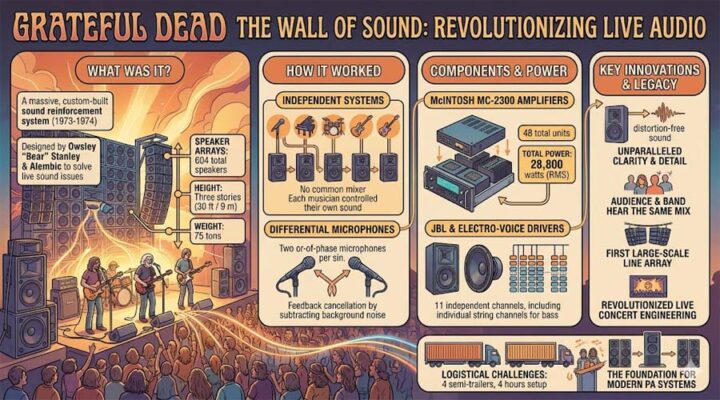
You cannot discuss the history of Grateful Dead live performances without talking about the monumental “Wall of Sound.” By the early 1970s, the band’s improvisational style had become so complex that traditional concert speakers simply could not handle their dynamic range. The sound was often muddy, and the band members struggled to hear each other on stage.
To solve this, their legendary sound engineer, Owsley “Bear” Stanley, designed an absolute behemoth of an audio system in 1974. The Wall of Sound was exactly what it sounded like: a massive, towering structure built from over 600 individual speakers placed directly behind the band.
It was an engineering marvel. It provided crystal-clear, distortion-free audio that could carry perfectly up to a quarter-mile away. Phil Lesh’s bass had its own dedicated channel, ensuring every single note hit the audience with chest-thumping clarity. While the Wall of Sound was ultimately retired after a year because it was an absolute logistical nightmare to transport and assemble, it forever changed the live music industry. It set a new standard for stadium acoustics, proving that live rock music did not have to sound chaotic – it could be a high-fidelity experience.
5. The Grateful Dead Live Jam Experience Explained
A typical concert followed a two-set structure.
The first set included shorter, more traditional songs. This helped both the band and the audience settle into the rhythm of the night.
The second set was where the real magic happened.
Songs became longer and more experimental. Jerry Garcia’s guitar work blended with Phil Lesh’s unique bass style, while Bob Weir provided rhythmic structure.
The drummers, Mickey Hart and Bill Kreutzmann, played a major role in shaping the sound.
Midway through the set, the band performed “Drums,” followed by “Space,” an experimental segment of pure improvisation. From this chaos, they would slowly return to a recognizable song, creating a powerful emotional moment for the audience.
6. Why Fans Followed the Band: Deadheads and the Shakedown Street Economy
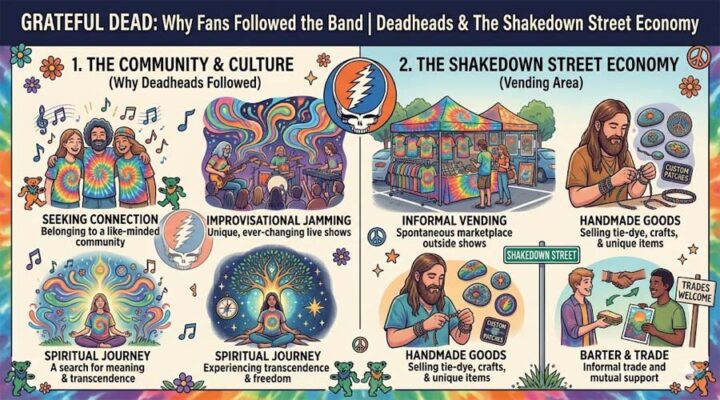
To understand the Grateful Dead, you have to understand the Deadheads.
Following the band was more than fandom. It was a lifestyle.
Fans traveled from show to show, forming a close-knit community. This culture came alive in the parking lots outside venues, known as “Shakedown Street.”
These areas became temporary marketplaces where fans sold food, handmade goods, and clothing.
It was also the best place to find unique Grateful Dead shirts. Independent artists created tie-dye designs, custom graphics, and one-of-a-kind pieces that could not be found in regular stores.
Buying from these vendors helped support the community and allowed fans to continue traveling with the band.
7. The End of an Era
After decades of touring, the band’s journey came to an end in 1995.
Their final show took place in Chicago on July 9, 1995. One month later, Jerry Garcia passed away.
His death marked a turning point. Without him, the band decided to officially end the Grateful Dead.
8. The Legacy of Grateful Dead Live Performances and Culture
Even after their final show, the influence of the Grateful Dead continues.
They created the blueprint for modern jam bands and proved that live performance could be the center of a successful music career.
Their legacy lives on through projects like Dead & Company, which features original members alongside John Mayer.
These performances continue to attract large audiences, showing that the culture is still alive today.
👉 If you want to understand these symbols, read: Grateful Dead Logo Meaning: Symbols, Bears, and Skull Explained
The Story Behind Iconic Grateful Dead Shirts and Merchandise
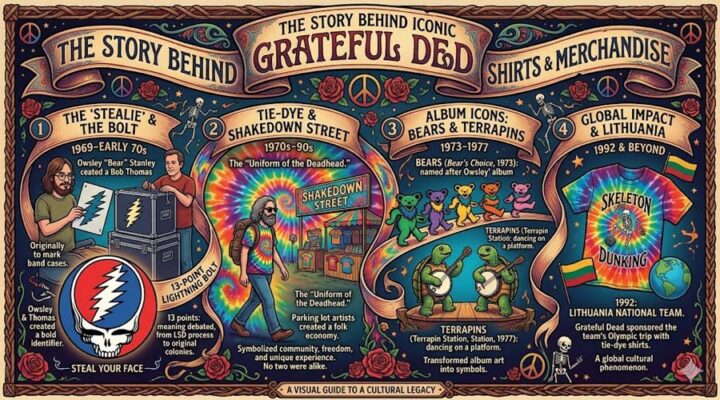
The visual identity of the Grateful Dead is just as legendary as their live jams. In fact, Grateful Dead band shirts have become some of the most sought-after vintage clothing items in the world. But these designs weren’t created by corporate marketing teams; they were born directly out of the live touring culture and the band’s eccentric history.
If you are a fan of rock-inspired apparel or graphic t-shirts, you are likely familiar with their most famous symbols:
-
The “Steal Your Face” Skull: Perhaps the most recognizable band logo in history, the skull with a lightning bolt striking through it was originally designed by Owsley Stanley and Bob Thomas. It wasn’t meant to be a fashion statement; it was literally painted on the band’s heavy equipment cases so they could easily identify their gear backstage at crowded festivals. Today, the “Stealie” is the ultimate centerpiece of vintage style graphic t-shirts.
-
The Dancing Bears: These colorful, marching bears are synonymous with a good time. Originally drawn by artist Bob Thomas for the back cover of the 1973 album History of the Grateful Dead, Volume One (Bear’s Choice), they were a playful nod to Owsley “Bear” Stanley. Today, these brightly colored bears are a staple on tie-dye apparel and modern streetwear.
-
Bertha (The Skeleton and Roses): Inspired by a 19th-century illustration, this iconic skull surrounded by a bed of roses perfectly captures the band’s blend of darkness and profound beauty. It remains one of the most popular motifs for fans looking for authentic, intricate band merch.
Today, fans continue to celebrate that undeniable legacy through vintage-style graphic t-shirts and modern reinterpretations of these classic designs. Whether you are drawn to bold psychedelic artwork, intricate tie-dye patterns, or subtle nods to the band’s touring history, Grateful Dead-inspired apparel remains one of the most enduring styles in rock culture. Wearing these shirts isn’t just about fashion; it is a way to carry the spirit of the lot, the jams, and the community with you everywhere you go.
Conclusion
The Grateful Dead were never just a band. They were a live experience that changed music forever.
Their concerts transformed traditional performances into something deeper and more meaningful. Through improvisation, risk taking, and a strong connection with their fans, they created a culture that still exists today.
From legendary shows like Cornell 1977 to the vibrant community of Deadheads, their influence continues across generations.
For fans old and new, one thing remains true. The music never stops.