
How Tony Iommi’s Guitar Riffs Changed the Language of Rock
Put aside the idea of guitar greatness as speed for a moment.
Tony Iommi’s importance does not come from playing the most notes, building the flashiest solos, or turning every song into a display of technique. His influence comes from something more structural: he changed what the guitar riff could mean inside a rock song.
In Black Sabbath, the riff was not just an opening hook. It was not just a part for the singer to stand on top of. It became the song’s center of gravity. The riff set the mood, shaped the rhythm, controlled the pressure, and gave the band’s sound its physical identity.
That is one reason Black Sabbath still matters. The band did not only make rock darker or louder. They helped turn the electric guitar into a tool for weight, tension, dread, and release.
Iommi did not create heavy metal alone, but his riff writing became one of the clearest foundations for how heavy music would use the guitar.
The Riff Became the Main Structure
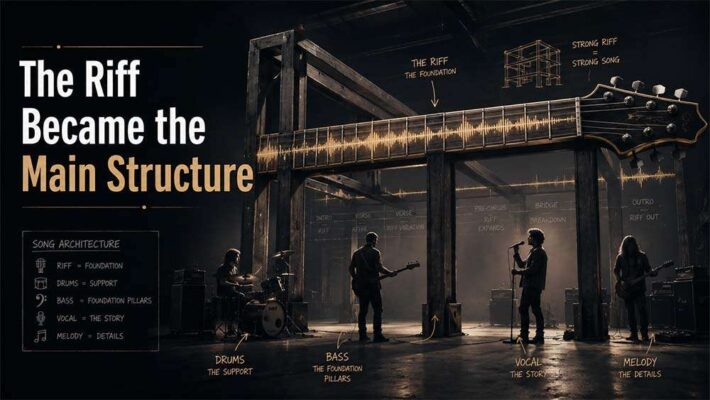
Many rock songs use riffs as memorable entry points. A riff can introduce the track, support the vocal, or give the listener something to recognize between verses.
Iommi pushed the riff into a more central role.
In early Black Sabbath, the riff often feels like the main structure of the song. Everything else gathers around it: bass, drums, vocal melody, atmosphere, and pacing. The song does not simply contain the riff. The song grows from it.
That change matters because it gives the guitar a different kind of authority.
In a Sabbath song, the riff often decides:
- how heavy the song feels
- how fast or slow the body wants to move
- where the vocal line sits
- how the bass locks in
- how much space the drums can occupy
- what kind of mood the listener enters
This is especially clear in “Black Sabbath.” The opening guitar figure does not behave like a standard rock hook. It feels more like a signal. The song begins by establishing an environment, not by chasing momentum.
Before the lyric explains anything, the guitar has already created the place where the song will happen.
That is one of Iommi’s great contributions. He showed that a riff could act like architecture.
Iommi Moved Rock Guitar From Motion Toward Weight
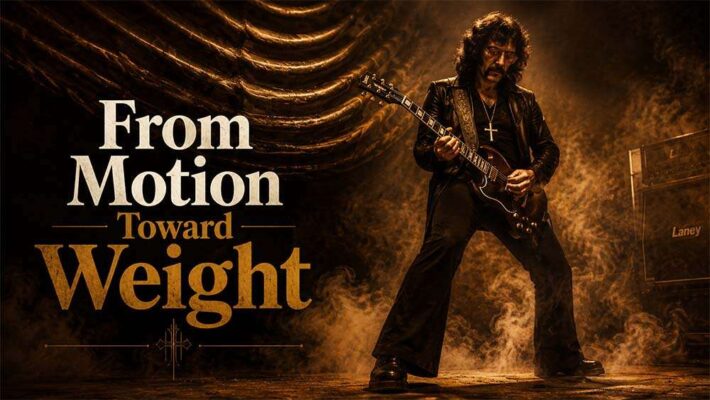
Late-1960s rock guitar had many powerful directions. Blues phrasing, improvisation, volume, feedback, groove, and extended soloing all helped expand what the instrument could do.
Iommi moved toward a different kind of force.
His playing often reduced movement instead of increasing it. He made the guitar feel heavier by slowing the riff down, lowering the tonal center, and letting each phrase sit longer in the air. The result was not less energy. It was energy turned into weight.
This shift from movement to weight is one of the main reasons Sabbath sounded different.
Iommi’s riffs often rely on:
- slow movement
- low, thick tones
- clear shapes
- heavy repetition
- space between phrases
- small intervals that create unease
- a sense of pressure rather than speed
The guitar no longer sounded like it was only trying to excite the listener. It could also trap the listener inside a feeling.
That idea would become essential to heavy metal. A riff did not need to run. It could stand still and become heavier.
Simple Shapes Made the Riffs Last
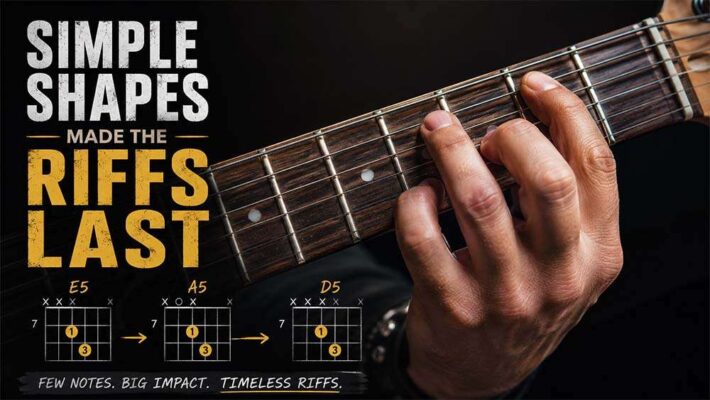
One of the easiest mistakes to make with Tony Iommi’s riffs is to confuse simplicity with weakness.
Many of his most famous riffs are not complicated on paper. They often use clear shapes, direct movement, and repeated patterns. But that clarity is exactly why they work.
A riff like “Iron Man” is easy to remember because its shape is strong. The line feels slow, mechanical, and almost inevitable. It does not need to impress the listener with complexity. It only needs to return with enough force that the listener feels it.
That is the power of simple riff architecture.
A complex riff can show skill. A simple riff with the right shape can define an entire song.
“Sweet Leaf” works in a different way. The riff has a loose, physical groove. It feels heavy, but not stiff. The repeated movement gives the song a body, almost like the band is leaning into the same phrase until it becomes impossible to ignore.
“Into the Void” is another important example. The riff feels lower, thicker, and more grounded. It points toward later doom, stoner, and sludge metal, not because it tries to be extreme, but because it understands how much weight a repeated guitar figure can carry.
Iommi’s best riffs last because they are easy to identify and hard to remove from memory. They are not crowded. They leave a strong outline.
That outline is what gives the riff its authority.
Timing Is Part of the Heaviness
A riff is not only a group of notes. It is also a matter of when those notes arrive.
Iommi’s riffs feel heavy because of timing. He often lets the listener wait. He gives the riff enough space to land, decay, and return. The delay between sounds becomes part of the pressure.
This is especially important in Sabbath’s slower material.
The opening of “Black Sabbath” works because it does not rush. The space between the notes creates suspense. The listener knows another note is coming, but the wait makes it heavier. The riff becomes less like a melody and more like a slow event.
That sense of timing is one reason Sabbath’s early sound still feels powerful without modern studio density. The band does not need to fill every second. It understands that emptiness can make the next hit feel larger.
This connects directly to why Black Sabbath still feels heavy without sounding modern. The heaviness is not only in the tone. It is in the placement.
Iommi knew that a riff becomes heavier when the listener has time to feel it.
Tone Turned the Guitar Into a Physical Object
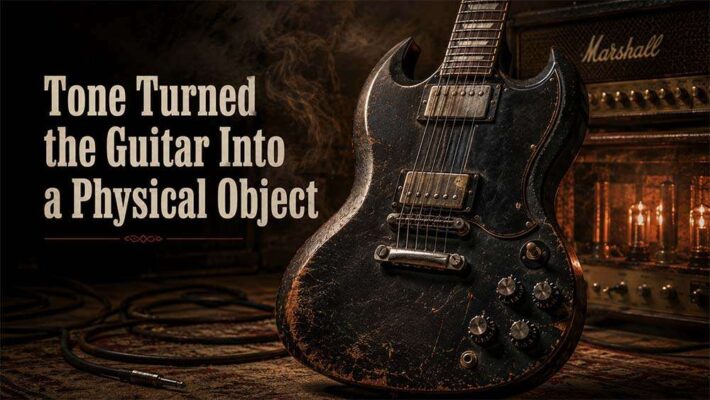
Iommi’s tone is central to his influence.
His guitar sound was not bright, clean, or decorative. It was darker, thicker, and more physical than much of the rock guitar around him. It did not have the extreme polish of later metal, but it had a heavy presence that felt unusually grounded.
Part of that sound came from adaptation. After injuring the tips of his fingers, Iommi used lighter strings and lower tuning to make playing easier. Those choices helped shape a darker, looser guitar feel that became part of Sabbath’s identity.
The result was more than a technical solution. It became a musical language.
His tone made the riff feel like an object in the room. You can sense the string movement, the amplifier response, and the rough edge of the performance. The guitar does not sound distant or decorative. It feels close, heavy, and textured.
That physical quality matters because Sabbath’s riffs often leave enough space for the tone to breathe. The listener can hear the note begin, hang, and decay.
The heaviness comes from tone with space around it.
The Band Built Around the Riff
Tony Iommi’s riffs were powerful on their own, but they became larger because the whole band understood how to build around them.
Geezer Butler’s bass did not simply duplicate the guitar. It often moved with its own personality, adding depth, motion, and tension. Bill Ward’s drums did not only keep time. They pushed, pulled, and reacted around the riff. Ozzy Osbourne’s vocal lines often mirrored or followed the guitar’s shape, which made the voice feel tied to the riff’s gravity.
This is why early Sabbath feels so unified.
The riff is not isolated from the band. It becomes the point where everyone meets.
In “Iron Man,” the vocal and guitar relationship is especially clear. The voice follows the weight of the riff rather than floating above it. That makes the whole song feel like one heavy body moving forward.
In “Children of the Grave,” the riff has more drive and urgency. The band locks into the forward motion, creating a different kind of heaviness. It is not as slow as some Sabbath material, but it still uses the riff as the main engine.
Iommi’s writing changed rock because it made the riff responsible for more than melody. The riff carried the song’s physical and emotional logic.
Later Heavy Music Expanded the Vocabulary
Tony Iommi’s influence is not that every heavy band after Sabbath sounded exactly like Sabbath. Many did not.
His influence is deeper than imitation.
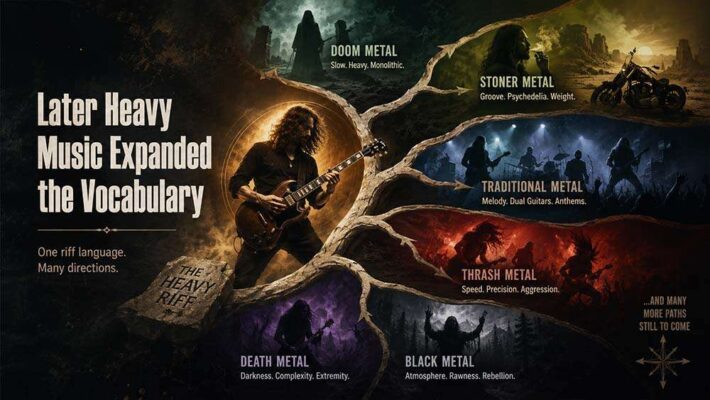
He helped establish a vocabulary that later bands could stretch, speed up, slow down, distort, sharpen, or make more extreme. Doom metal expanded Sabbath’s slow weight. Stoner and sludge metal drew from the thick tone, repetition, and physical groove. Traditional heavy metal used the riff as a driving force and made it faster and more dramatic. Extreme metal often pushed speed and aggression much further, but still depended on the idea that a riff can create pressure.
The key idea is riff as weight.
That idea runs through much of heavy music. A riff can be a hook, but it can also be a landscape. It can push a song forward, but it can also hold the listener in place. It can be catchy, but it can also feel oppressive.
Iommi’s riffs gave heavy music a way to think through the guitar.
That is why his influence remains so wide. Later bands changed the surface, but the deeper principle stayed useful: the guitar riff could become the main source of identity, force, and atmosphere.
Why Iommi’s Riffs Still Work
Tony Iommi’s riffs still work because they do not depend on novelty.
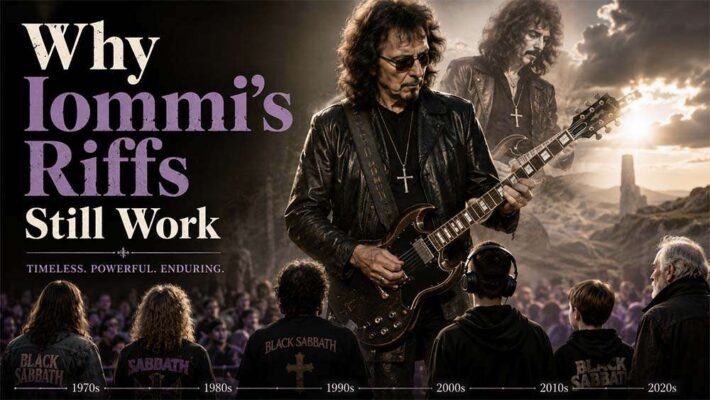
They are not impressive only because they were early. They remain powerful because they are built with strong shapes, careful timing, physical tone, and enough space to let the listener feel the weight.
The creeping opening of “Black Sabbath” still feels unsettling because of its slow arrival. “Iron Man” still feels powerful because of its mechanical clarity. “Sweet Leaf” still works because of its loose, physical groove. “Into the Void” still feels heavy because the riff is low, patient, and grounded.
These songs do not need modern production to make their point.
That is also why Paranoid continues to matter across generations. Its riffs are not only historically important. They still connect with pressure, anxiety, and release in a direct way, a theme explored further in Why Paranoid Still Speaks to Anxious Generations.
Iommi changed the language of rock by proving that the guitar could do more than decorate a song or display skill. It could define the space of the song. It could make a simple phrase feel monumental. It could turn silence into tension and repetition into force.
Most importantly, it could make heaviness feel physical.
Guitar Listening Note
This article is written from a guitar-focused listening perspective, looking at how Tony Iommi’s riffs changed the role of the electric guitar in rock music. It focuses on riff shape, timing, tone, repetition, band interaction, and physical weight, treating the riff not only as a hook, but as the structural language that helped define heavy metal.