
Why HYYH Feels Different From Other BTS Eras
Many fans who no longer actively follow every comeback still revisit HYYH (Hwa Yang Yeon Hwa or The Most Beautiful Moment in Life) years later. Interestingly, this magnetic pull is rarely about pure nostalgia for 2015, and fans often revisit it indirectly. Instead of simply replaying full albums, they return through old lyric translations, nostalgic fan edits, specific pastel color palettes, and saved concept photos during moments of vulnerability.
Originally released between 2015 and 2016, HYYH marked a major turning point in BTS storytelling. The era spanned multiple albums, music videos, and a complex web of narrative symbolism centered around youth, impermanence, and transition.
Over time, HYYH begins to function less like a typical promotional cycle and more like an emotional memory architecture. It captures an unresolved transition, a state fans revisit whenever life feels unexpectedly unanchored. While our comprehensive guide on Understanding BTS Through Symbolism, Eras, Visual Identity & Fan Culture maps out the entire emotional ecosystem of the fandom, understanding the specific gravity of HYYH requires looking at how it uniquely encoded the messy reality of growing up better than any other period in the group’s history.
Why HYYH Rarely Feels Like Just an Album Era
Most pop music eras are remembered as visual aesthetics or soundtracks to a specific period of life. HYYH is remembered differently. For many fans, it feels less like content they consumed and more like an emotional environment they temporarily lived inside.
Why HYYH Stands Apart Within the BTS Discography
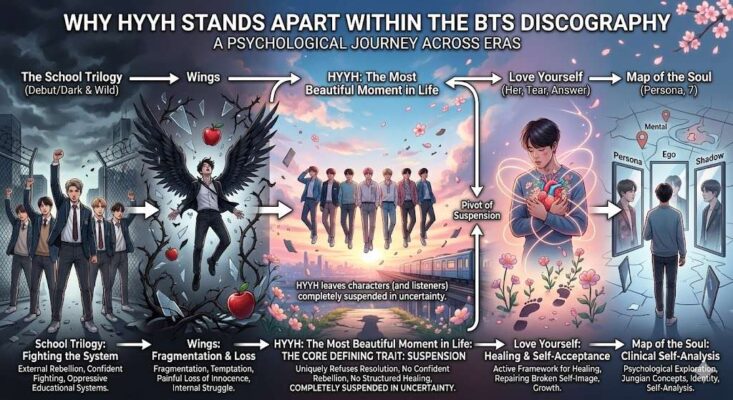
A long-term listener looking back at the group’s catalog will notice a distinct pattern in how psychological themes are handled. To understand the specific weight of HYYH, it is necessary to compare it directly to the eras that came before and after it.
Most BTS eras operate with a clear emotional directive:
-
The School Trilogy: Focused on external rebellion and fighting back against oppressive educational systems.
-
Wings: As explored in our deep dive into the psychological themes and visual language of the BTS Wings era, this period focused on fragmentation, temptation, and the painful loss of innocence.
-
Love Yourself: Functioned as an active framework for healing and repairing a broken self-image.
-
Map of the Soul: Operated as clinical, Jungian self-analysis of the persona and the ego.
HYYH stands entirely alone because its core defining trait is suspension. It does not offer the confident rebellion of their debut, nor does it provide the structured healing of Love Yourself. HYYH uniquely refuses resolution. It is the only era that leaves its characters, and by extension its listeners, completely suspended in uncertainty.
The Impact of Age Synchronization
Beyond the thematic differences, HYYH holds a unique weight because of timing. HYYH arrived before BTS became untouchable global celebrities. The group still felt emotionally reachable, imperfect, and uncertain themselves. Fans were not simply observing the group’s growth from a distance; they felt like they were growing alongside them.
Later eras often felt aspirational, but HYYH felt simultaneous. Fans were not looking up at success yet. They were standing beside uncertainty. This synchronization created a bond that later eras, produced from the heights of global superstardom, could not naturally replicate.
The Emotional Timing of Transitional Anxiety

The reason this era resonated so deeply with fans in their late teens and early twenties comes down to how it articulated the exact anxieties that a specific generation was facing in real-time. It spoke directly to the highly specific terror of undefined adulthood.
The Fear of Falling Behind
The narrative of HYYH does not focus on traditional ambition. Instead, tracks from this period articulate the suffocating pressure of academic expectations, career uncertainty, and the quiet fear of falling behind peers. For many listeners entering university, failing exams, choosing career paths, or facing precarious first jobs, HYYH arrived at the exact emotional frequency of that uncertainty. It captures the specific anxiety of standing on a starting line and realizing you are already exhausted by the expectations placed upon you.
Friendship as a Fragile Anchor
The storyline heavily centers on the fragile nature of youth friendships. Rather than portraying friendship as an unbreakable bond, HYYH presents it as a temporary anchor. It highlights the bittersweet, highly realistic realization that the people keeping you afloat right now might not be there when you finally cross the threshold into adulthood.
The Comfort of Temporary Safety
Part of HYYH’s emotional power comes from how fleeting its happiness feels. It is not entirely about pain; it is about beautiful impermanence. Moments of laughter around a bonfire, cramped group bus rides, and quiet camaraderie never appear permanent. Fans are constantly shown brief safety before uncertainty inevitably returns. This mirrors how many people remember youth itself: not as stable, continuous happiness, but as temporary relief between moments of deep confusion.
Borrowed Spaces and Visual Impermanence
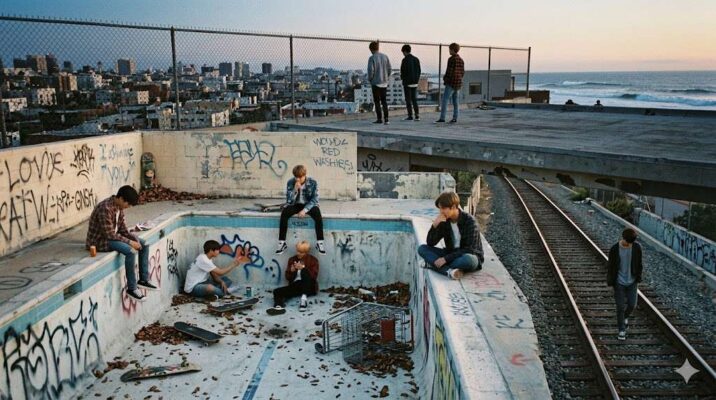
Rather than relying on high-budget, polished studio sets, the visual language of HYYH is grounded in liminal, forgotten spaces. A core reason these visuals feel emotionally familiar is that HYYH rarely places its characters inside stable, permanent environments.
They exist in borrowed spaces: rooftops, empty stations, cheap motels, and abandoned lots. These are places people pass through rather than settle in, which perfectly mirrors the emotional condition of early adulthood itself.
-
Rooftops: Elevated above the city and away from adult eyes, offering a brief, temporary illusion of freedom.
-
Train Tracks: A recurring motif symbolizing constant movement without a clear destination.
-
Abandoned Pools: Relics of past joy, now hollowed out, mirroring the feeling of outgrowing one’s childhood.
-
The Ocean: Frequently used to represent emotional scale and uncertainty. Standing at the edge of the water is standing at the edge of the known world, unsure of what comes next.
These environments trigger a visceral recognition because they look exactly like the backdrop of real coming-of-age memories: unpolished, slightly dangerous, and entirely temporary.
The Psychology of “Almost” (The Core Refusal of Resolution)
The most significant psychological mechanism of HYYH is how it perfectly encodes the psychology of “almost.”
Most BTS eras eventually move toward emotional clarity. Wings pushes through trauma to find ambition; Love Yourself actively works toward self-forgiveness. HYYH does the exact opposite. It suspends its characters in uncertainty without promising any transformation. We see almost adulthood, almost happiness, almost escape. The characters in the music videos are constantly running, but they are never shown arriving at a destination.
By refusing to offer a neat conclusion, HYYH validates the listener’s own feelings of being stuck in the messy middle chapters of their own lives. Fans are not invited to overcome their pain in HYYH. They are invited to sit inside it.
Adulthood Reinterpretation: Why Fans Keep Returning at Age 30

The way a fan experiences this era changes drastically over a decade. At 18, the era felt like a real-time reflection of their immediate pain. At 30, however, HYYH becomes a melancholic sanctuary.
Many fans revisit HYYH during career changes, burnout, breakups, or moments when adulthood feels unexpectedly precarious. Returning to it provides the reassurance that it is acceptable to still be figuring things out, even years after you were supposed to have all the answers. What once felt like youthful sadness starts feeling more like unresolved nostalgia.
Private Symbolism: How HYYH Shaped Fan Apparel
Because the emotional pull of this era is so deeply ingrained, it naturally spills over into how fans express their identity. However, HYYH fan fashion functions less like merchandise and more like private symbolism.
Compared with louder concert apparel, HYYH-inspired outfits tend to lean toward muted aesthetics. A fan might choose a faded hoodie, an embroidered date, a minimalist butterfly motif, or muted typography referencing a fictional location from the storyline. For many, these quiet visual cues feel more emotionally authentic than oversized logos because the meaning already exists internally. This subtle styling allows adult fans to carry the comforting familiarity of that specific life stage into their daily routines, shared only with those who understand the visual language of that unresolved transition.
Conclusion
HYYH remains a focal point of the BTS fandom because it never tries to offer a neat, happy ending. It is a time capsule of emotional uncertainty. That may be why fans rarely leave HYYH completely. Even after years away from BTS, many still return to it during moments of transition, not for answers, but for recognition.