
The Psychological Themes and Visual Language of the BTS Wings Era
For many fans, Wings feels emotionally darker than earlier BTS eras without ever becoming hopeless. Unlike HYYH, which suspended listeners inside uncertainty, Wings confronts what happens after innocence begins to crack. If HYYH feared becoming an adult, Wings feared what adulthood might reveal.
This 2016 era remains a pivotal chapter in the BTS discography because it shifted the emotional focus of BTS storytelling from surviving uncertainty to confronting the uncomfortable parts of yourself. While our broader guide on Understanding BTS Through Symbolism, Eras, Visual Identity & Fan Culture maps out the overarching emotional ecosystem of the fandom, understanding why Wings carries such a distinct, heavy weight requires looking past the lore to examine how it specifically captured the psychology of fragmentation.
Why Wings Feels Like the Emotional Consequence of HYYH
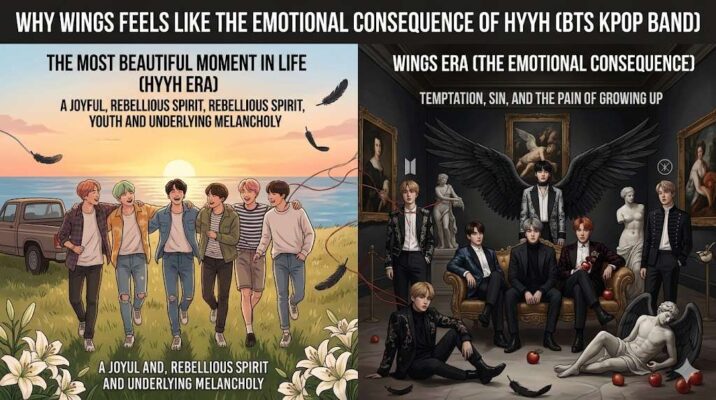
It is impossible to understand the emotional depth of Wings without first understanding why HYYH feels different from other BTS eras. The two periods operate as a direct psychological cause and effect.
HYYH was defined by liminal youth, temporary safety, and the belief that friendship could serve as a protective barrier against the outside world. Wings shatters that illusion. It removes the safety net. While HYYH still believed friendship might save you, Wings quietly suggests that some struggles happen inside you alone.
This shift is incredibly apparent in the environmental storytelling. HYYH lived in borrowed spaces like empty train stations, abandoned pools, and rooftops where the characters could hide together. Wings moves inward into psychological spaces. The characters are suddenly isolated in surreal, enclosed rooms, trapped not by society, but by their own minds.
Temptation, Shame and the Fear of Growing Up
Most coming-of-age narratives focus on the fear of failing. Wings subverts this entirely by treating the transition into adulthood as a site of profound moral conflict, heavily centering on the concept of shame.
The Fear of Becoming Someone Else
The core terror in Wings is not failure; it is transformation. Growing up inevitably means discovering parts of yourself you do not fully trust. The narrative captures the acute anxiety of realizing you are capable of making destructive choices. This resonates violently with adult fans, particularly those in their late twenties, experiencing career identity crises, burnout, or the sudden realization that they no longer recognize the person they have become.
Moral Ambiguity and the End of Innocence
Wings is emotionally heavier because it removes simple villains. In the School Trilogy, the enemy was the educational system. In HYYH, the enemy was bad circumstances and impending adulthood. In Wings, the enemy is yourself. It dismantles the black and white morality of childhood, forcing the realization that making compromises is an unavoidable part of survival. It introduces a messy, painful accountability.
Self-Sabotage, Shame, and Regret
This era addresses the very real human tendency to make destructive choices. It does not sanitize the mistakes of early adulthood. Fans often revisit this era during periods of burnout, relationship failures, or the aftermath of bad decisions. Wings resonates deeply when people feel disappointed in themselves: not just when they feel sad, but when they feel ashamed. It validates the heavy burden of having to figure out how to live with your own regrets.
Why Demian Became Emotionally Important to Wings
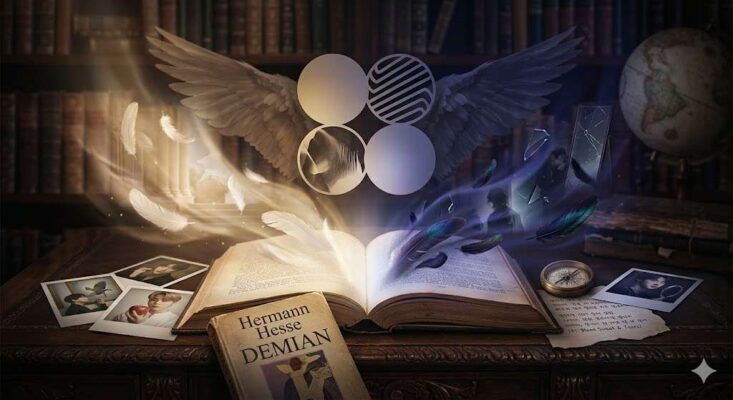
The Wings era famously drew heavy inspiration from Hermann Hesse’s coming-of-age novel, Demian. However, treating this era simply as a literature summary entirely misses the point. Why did fans emotionally connect to Demian even if many of them never finished reading the book?
Because the fandom connected to the emotional architecture of Demian more than the plot itself.
The core concepts of the novel, such as fractured identity, the collision of light and dark worlds, moral ambiguity, and painful self-discovery, provided an exact vocabulary for what fans were feeling in their own lives. Wings borrowed the framework of the book to give fans permission to view the pain of outgrowing their current life not as a failure, but as the necessary, destructive act of hatching into something new.
Understanding the Visual Language of Wings
When the Wings concept photos and short films dropped, fans instantly understood the mood. The visuals feel emotionally intuitive because they resemble internal conflict made physical.
-
Mirrors: Represent the fractured self. Characters are constantly forced to look at reflections they want to avoid, confronting the shadow self they are trying to hide.
-
Blindfolds: Symbolize chosen ignorance and the fear of truth. They represent the seductive comfort of refusing to see reality for what it is.
-
Wings: Represent freedom, but explicitly a freedom that comes with permanent consequences and loss of innocence.
-
Statues: Stand for impossible perfection. When they crack or cry colorful tears, it visually represents the breaking of a perfect, idealized self-image.
-
Dark Luxury: Velvets, absinthe, and opulent European architecture replace the cheap motels of HYYH. This seductive adulthood signals that the danger is no longer external poverty, but internal temptation.
-
Cracked Imagery: Mirrors the damaged, fragmented identity of someone going through a profound psychological shift.
Why Wings Feels Especially Personal During Difficult Life Periods
Fans cycle through different BTS eras depending on their current psychological needs. If fans return to HYYH when life feels uncertain, they return to Wings when life requires self-confrontation.
Fans often return to Wings not when life feels uncertain, but when life feels psychologically heavy. It is the chosen soundtrack for moments when life feels overwhelmingly heavy, such as navigating deep career disappointment, failed relationships, drifting friendships, or severe identity confusion. When a fan is carrying a heavy burden of guilt, bright messages of self-love can sometimes feel alienating or unearned. Wings sits in the dark with the listener. It offers the specific comfort of being understood when your mind feels like a complicated, heavy place to live.
Why Wings Quietly Influenced Fan Style
The gothic, psychological weight of Wings left a lasting mark on how fans express their identity visually. However, Wings inspired fashion often feels less nostalgic than protective.
Unlike HYYH inspired fashion, which often feels nostalgic and soft, Wings inspired styling tends to feel structured and protective. The aesthetic heavily overlaps with “dark academia.” Fans gravitating toward this era often build wardrobes around black palettes, vintage luxury, distressed tailoring, and symbolic jewelry. A fan might choose a structured dark blazer, a minimalist feather embroidery, or a subtle cracked statue motif.
This type of apparel allows fans to project the depth of the Wings era in a workplace-safe way. It acts as a form of emotional armor, allowing the wearer to carry the complex, mature weight of self-confrontation into their everyday routines without having to explain it to anyone else.
Conclusion
Wings remains emotionally relevant because it never romanticizes growth. It frames adulthood not as liberation, but as confrontation. Fans return to it because some stages of life feel less like becoming yourself and more like learning to live with the parts of yourself you never expected to meet. By refusing to look away from the darker parts of growing up, Wings remains a vital, honest anchor for those navigating the heaviest parts of their own lives.