
BTS Map of the Soul Era: The Exhaustion of the Persona and the Architecture of Identity
For many adult fans, the BTS Map of the Soul era functions less like a pop album and more like a clinical diagnosis. If previous eras offered a shoulder to cry on, this era offers a mirror and a vocabulary. Released as the South Korean group reached the absolute apex of global superstardom, this specific chapter of the BTS discography turns its gaze entirely inward, asking what happens when the mask you wear for the world starts to suffocatingly fuse with your actual face.
Anyone Understanding BTS Through Symbolism, Eras, Visual Identity & Fan Culture will notice that the group’s storytelling consistently mirrors the listener’s own psychological growth. Fans anchor themselves so deeply to Map of the Soul because it perfectly articulates the exhaustion of adulthood, the fear of losing your passion, and the heavy, unglamorous work of figuring out who you actually are.
From Healing to Diagnosis: The Shift From Love Yourself
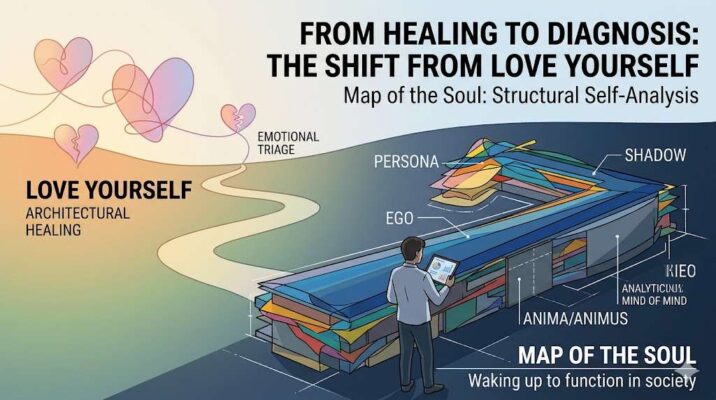
To understand the emotional utility of Map of the Soul, it must be placed at the end of the psychological timeline BTS built over five years. As we explored in our analysis of how Love Yourself built an architecture of healing, the previous era provided the emotional triage needed to survive a fracture.
-
HYYH suspended the listener in the uncertainty of youth.
-
Wings fractured their innocence and forced a confrontation with the darker self.
-
Love Yourself provided the emotional triage and repair needed to survive that fracture.
Map of the Soul is the intellectual conclusion to this BTS cycle. Once you have healed, you still have to wake up and go to work. You still have to figure out how to function in society. This era shifts the narrative from emotional repair to structural self-analysis. It borrows heavily from Carl Jung’s psychological theories, not as an academic exercise, but as a practical framework for fans to understand their own internal exhaustion.
The Exhaustion of the Persona
The most resonant psychological theme of this era is the concept of the Persona: the social mask we construct to navigate the world, keep our jobs, and meet societal expectations.
For fans navigating corporate environments, higher education, or demanding family roles, this era hits with brutal accuracy. It does not demonize the mask; it acknowledges that the mask is necessary for survival. However, it deeply explores the exhaustion that comes from wearing it too long. Fans connect to this BTS era when they feel entirely hollowed out by their own competence. It highlights the specific, isolating fatigue of being exactly who everyone needs you to be at the expense of remembering who you are in private.
The Black Swan and the Fear of Apathy

Perhaps the most potent and terrifying concept introduced in this era is the Black Swan. It addresses a highly specific adult fear: what happens when the thing you love most becomes a chore?
The BTS track “Black Swan” explores the first death of an artist, meaning the moment passion turns into mechanical obligation. For adult fans experiencing severe career burnout, imposter syndrome, or a loss of creative spark, this concept provided an immediate, devastatingly accurate vocabulary. It validates the terrifying numbness that occurs when you achieve your goals but feel absolutely nothing, framing apathy not as laziness, but as a profound psychological crisis.
Integrating the Shadow (The Evolution from Wings)
Wings and Map of the Soul both deal heavily with the Shadow, representing the repressed, darker elements of the psyche. However, the way fans use these two BTS eras is entirely different.
In Wings, the shadow is a terrifying, seductive force that causes shame and fragmentation. By the time the narrative reaches Map of the Soul, the relationship with the shadow has matured. The goal is no longer to fight it or feel ashamed of it. The goal is integration.
Map of the Soul tells the listener that the shadow is just a roommate you have to learn to live with. It represents the quiet, mature realization that your flaws, traumas, and darker impulses will never permanently disappear, but they can be acknowledged and managed without destroying you.
The Visual Architecture of the Mind
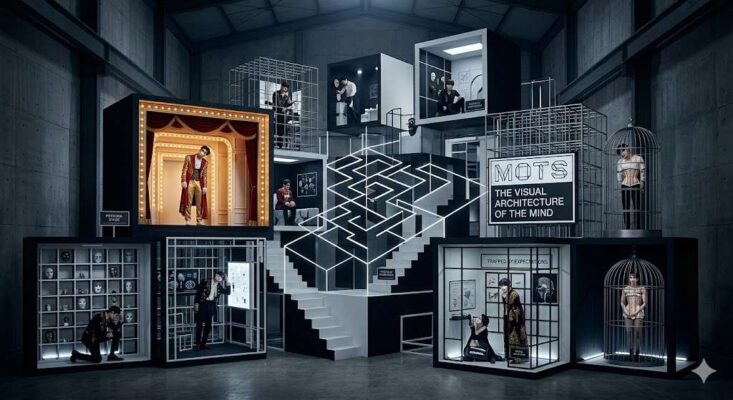
The visual language of the BTS Map of the Soul era abandons the liminal spaces of HYYH and the gothic luxury of Wings. Instead, the visuals operate as a literal architecture of the mind, using highly structured, theatrical imagery.
-
Theatrical Sets and Stages: Characters are frequently shown performing on literal stages or inside boxed dioramas. This visually reinforces the exhausting, performative nature of the Persona.
-
Stark Contrasts and Grids: The aesthetic relies on clean lines, stark black and white contrasts, and geometric shapes. It feels analytical, mimicking the process of trying to neatly categorize the messy parts of the human mind.
-
Cages and Corsets: Physical representations of being trapped by external expectations, perfectionism, and the very masks they created to protect themselves.
These visuals resonate because they feel less like emotional expressions and more like internal maps. They give fans a structured way to visualize their own mental compartmentalization.
Why Adult Fans Use This Era During Identity Crises
Fans of BTS do not typically return to Map of the Soul when they need a quick emotional comfort blanket. They return to it when they need clarity.
This era is the chosen framework for periods of intense identity confusion, quarter-life crises, and professional burnout. When a fan is standing at a crossroads, feeling entirely detached from the life they have built, this era provides a clinical, deeply understanding space to disassemble their life and examine the pieces. It validates the desire to strip away the expectations of colleagues, parents, and society to find whatever is left underneath.
Apparel as Intellectual Armor

Because Map of the Soul is a highly analytical, structured BTS era, the fan expression and apparel surrounding it reflect a different kind of stealth fandom. It moves away from the nostalgic vintage washes of HYYH and the soft symbolism of Love Yourself.
Map of the Soul inspired fashion often functions as intellectual armor. The aesthetic is clean, typographical, and sharply structured. Fans gravitate toward crisp black and white palettes, minimalist grid designs, or subtle psychological terminology (like the words “Persona” or “Shadow”) cleanly embroidered on structured garments.
This style is the ultimate corporate-safe fandom. It allows a fan experiencing severe workplace burnout to wear their internal struggle as a subtle, sharply designed badge of honor. To the outside world, it looks like modern, minimalist streetwear. To the wearer, it is a quiet reminder to separate their true self from the job they are currently performing.
Conclusion
Map of the Soul remains a critical pillar of the BTS ecosystem because it refuses to provide easy emotional platitudes. It treats the listener as an adult capable of doing the heavy, clinical work of self-analysis. Fans return to this era because it confirms that figuring out who you are is not a magical journey of self-discovery. Instead, it is a lifelong, exhausting, and necessary negotiation between the mask you wear and the shadow you hide.