
The BTS Love Yourself Era and the Architecture of Healing
Many fans describe the BTS Love Yourself era less as an album cycle and more as emotional recovery. While pop music frequently promotes self-love as a catchy slogan or an instant fix, this specific chapter of the BTS discography built a highly structured framework for actual emotional repair.
For anyone Understanding BTS Through Symbolism, Eras, Visual Identity & Fan Culture, this period stands out as a radical shift in how pop culture addresses mental health. To understand why fans emotionally depend on this era, it is necessary to look at how it redefined the concept of healing from a generic hashtag into a messy, ongoing psychological process.
Why Healing in BTS Never Feels Linear

Healing in the BTS universe is never presented as a straight line. It does not look like motivational quotes or overnight transformations. Instead, the era focuses on the setbacks, the lingering shame, and the extreme vulnerability required to actually change.
Fans attach to this narrative because it acknowledges that emotional recovery involves relapsing into old habits, feeling exhausted by the effort, and having to choose to try again the next morning. It tells the listener that taking two steps back does not erase the progress they have made, providing a deeply realistic view of mental and emotional health.
Why “Loving Yourself” Felt Different From Pop Positivity
The cultural landscape is saturated with generic pop positivity that demands constant happiness. Love Yourself felt radically different because it actively rejected this fake positivity.
The era acknowledges that forcing yourself to be happy is just another form of self-harm. It presents a messy healing process where anger, grief, and self-doubt are treated as necessary steps rather than character flaws. Fans do not look to this era for superficial cheerfulness. They look to it for the reassurance that healing can be ugly, incomplete, and still be entirely valid.
The Emotional Shift From Wings to Love Yourself
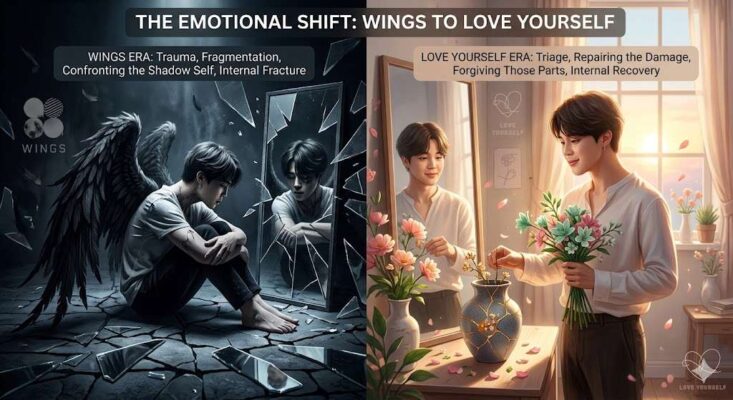
To fully grasp the weight of this era, we have to look at the psychological progression from the previous chapter. The two periods operate as a necessary sequence of trauma and triage.
If the psychological themes of the BTS Wings era were about fragmentation, confronting the shadow self, and watching innocence break, Love Yourself is the quiet, exhausting work of repairing the damage. Wings forced the characters to look at the darkest parts of themselves. Love Yourself asks the much harder question of how to forgive those parts. It is the necessary recovery period after a profound psychological fracture, shifting the narrative from internal confrontation to internal repair.
The Symbolic Language of Love Yourself
The era relies on a distinct visual system to communicate its psychological themes. This system bypasses direct explanation in favor of emotional intuition, allowing fans to project their own experiences onto the imagery.
Flowers and Fragility
Floral motifs dominate this period, but they are rarely presented as simple decorations. Flowers are shown blooming, withering, shedding petals, or burning. This fragility represents the temporary nature of beauty and the delicate state of a person trying to rebuild their self-esteem.
Broken Reflections
Continuing the motif of mirrors seen in previous eras, the characters often interact with broken or distorted reflections. This symbolizes the ongoing struggle to reconcile who they actually are with the idealized, perfect version they want the world to see.
The Performance of Happiness
The darkest chapter of this era focuses entirely on the optical illusion of being okay. The visuals use shifting gradients, masks, and forced smiles to represent the psychological toll of hiding your true pain just to keep the people around you comfortable. It perfectly captures the exhaustion of performing happiness.
Soft Colors and Emotional Space
Unlike the heavy, dark velvets of Wings, the broader Love Yourself aesthetic uses soft pastels, white spaces, and gentle gradients. This creates a visual representation of a safe psychological room. It acts as a place where the listener is allowed to breathe, rest, and exist without external pressure.
Why Fans Return to This Era During Hard Periods
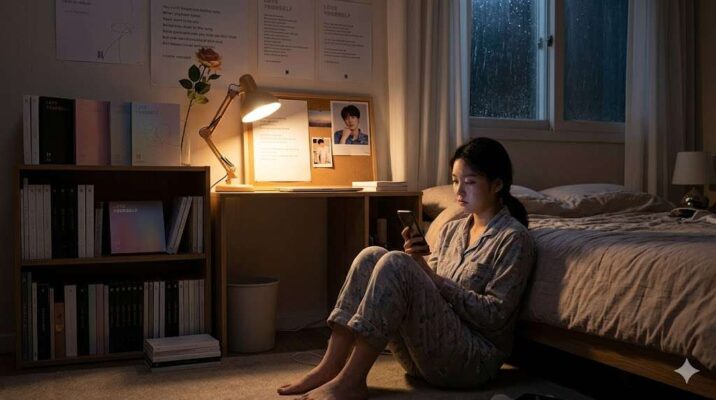
Fans do not return to this era to celebrate success. They return to it during moments of acute emotional distress, such as dealing with heartbreak, severe burnout, profound loneliness, and deep insecurity.
When navigating the overwhelming exhaustion of corporate burnout or the quiet devastation of a failed relationship, loud motivational anthems often feel alienating. Love Yourself offers something much rarer. It offers a gentle, non-judgmental space to rest. It provides a psychological safety net for adult fans who are completely tired of pretending to be strong, giving them the exact words they need to hear when they cannot find their own. Before listeners are ready to move into the deep clinical self analysis of the Map of the Soul era, this healing phase is completely necessary.
How Love Yourself Changed Fan Expression
The gentle, introspective nature of this era fundamentally changed how fans translate their connection into personal style. The aesthetic shifted heavily toward softer elements, resulting in apparel that prioritizes emotional subtlety over loud branding.
Fans inspired by this era often gravitate toward minimalist line art, soft color gradients, and symbolic floral motifs. A fan might wear a plain white hoodie with a delicate, continuous line drawing of a flower on the chest, or a pastel accessory referencing the era’s albums. This symbolic fashion functions as a quiet daily reminder of self compassion. It allows fans to carry the architecture of healing into highly professional or stressful environments, keeping a private source of comfort close at hand without drawing unwanted attention.
Conclusion
Love Yourself remains a cornerstone of the BTS fandom because it treats healing as unfinished work rather than a final destination. It never promises that the pain will disappear forever. Instead, it offers a realistic, compassionate blueprint for surviving the bad days. Fans emotionally depend on this era because it provides the constant, quiet reassurance that simply trying to get better is enough.